


.svg)


How Multifamily Operators Can Strengthen NOI When Occupancy Softens

- National multifamily occupancy dropped to 94.2% in early 2026, and rent growth slowed to just 0.2% year-over-year, putting real pressure on property-level NOI.
- Operators are prioritizing occupancy over rent increases, with 57% of all leasing activity now coming from renewals rather than new leases.
- The biggest lever most operators are not fully using is applicant-to-lease conversion. Widening the qualified applicant pool without relaxing standards is where meaningful occupancy gains are hiding.
- Cosign lets operators approve renters who fall outside traditional credit thresholds, including international professionals, recent graduates, and self-employed earners, without taking on additional risk.
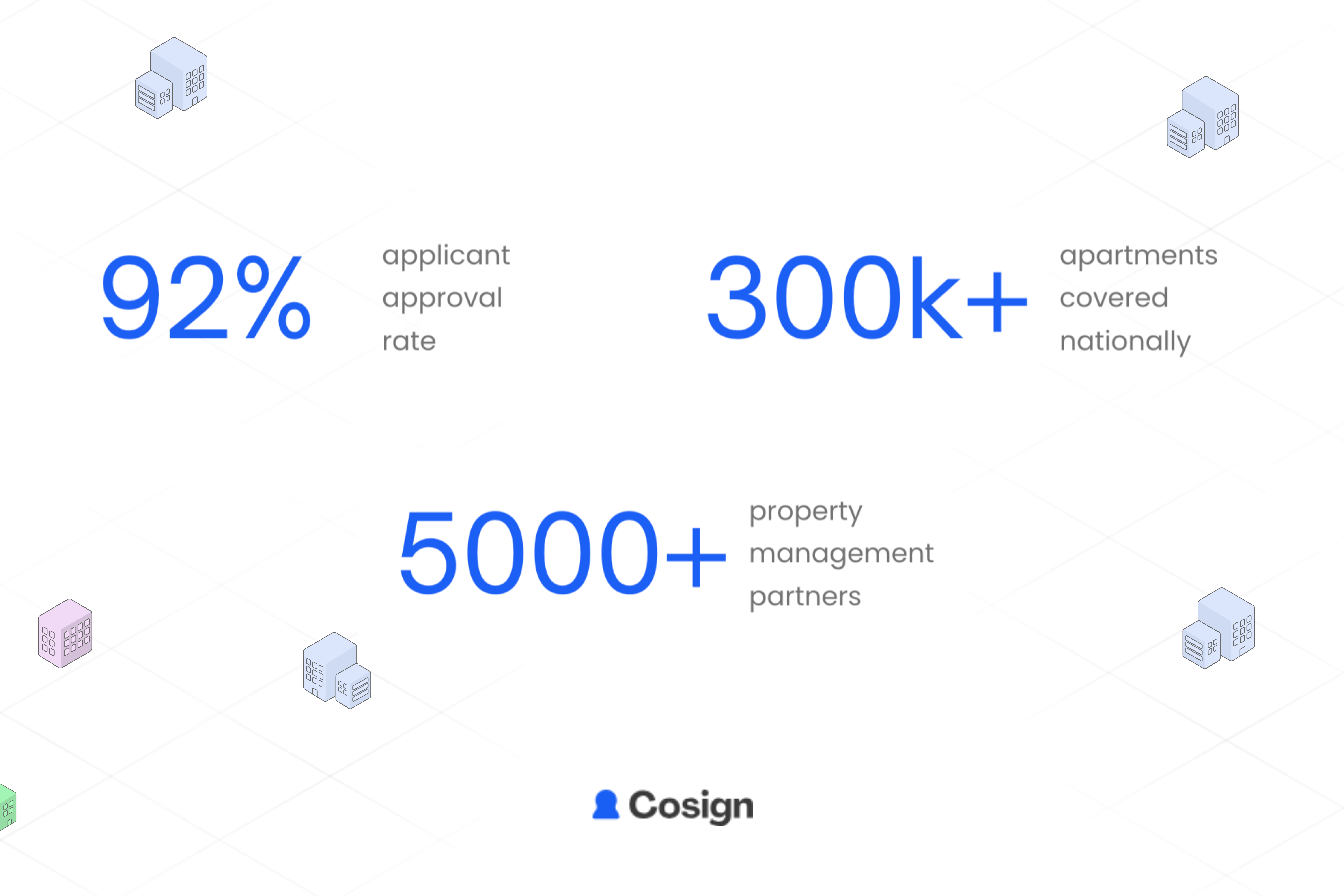
- Properties using Cosign have seen applicant-to-lease conversion rates improve by 10% or more, with one operator adding $4M in annual revenue through expanded approvals alone.
The math is unforgiving right now. National asking rent growth sat at just 0.2% year-over-year through mid-2026, the weakest pace since 2012, according to Yardi Matrix's Q1 2026 report. At the same time, national occupancy dipped to 94.2% in March 2026, with more than two-thirds of the top 30 metros recording year-over-year declines. Sun Belt markets like Austin, Phoenix, and Denver are seeing vacancy levels operators haven't had to manage since the early post-pandemic reset.
In that environment, protecting NOI does not come from pricing power. It comes from occupancy. And for most operators, the fastest path to improved occupancy is not more marketing spend. It is getting more of the qualified applicants already touring your property across the finish line.
Why Lease Conversion Is the Highest-ROI Variable Right Now
Most revenue discussions in multifamily center on rent pricing. That conversation matters, but its impact is constrained when effective asking rent growth is running at 0.6% or below. A property achieving 95% occupancy at current rents dramatically outperforms one achieving 91%, even if the latter has a slightly higher per-unit rate.
CBRE's 2026 Multifamily Outlook found that 57% of all leasing activity now comes from renewals, up from 51% in 2015. That is genuinely positive news for retention-focused operators. But it also means the pool of new lease prospects is thinner. Every qualified applicant who walks away without signing represents a gap that is increasingly hard to backfill quickly.
The logical question is: how many qualified applicants are you losing at the approval stage?
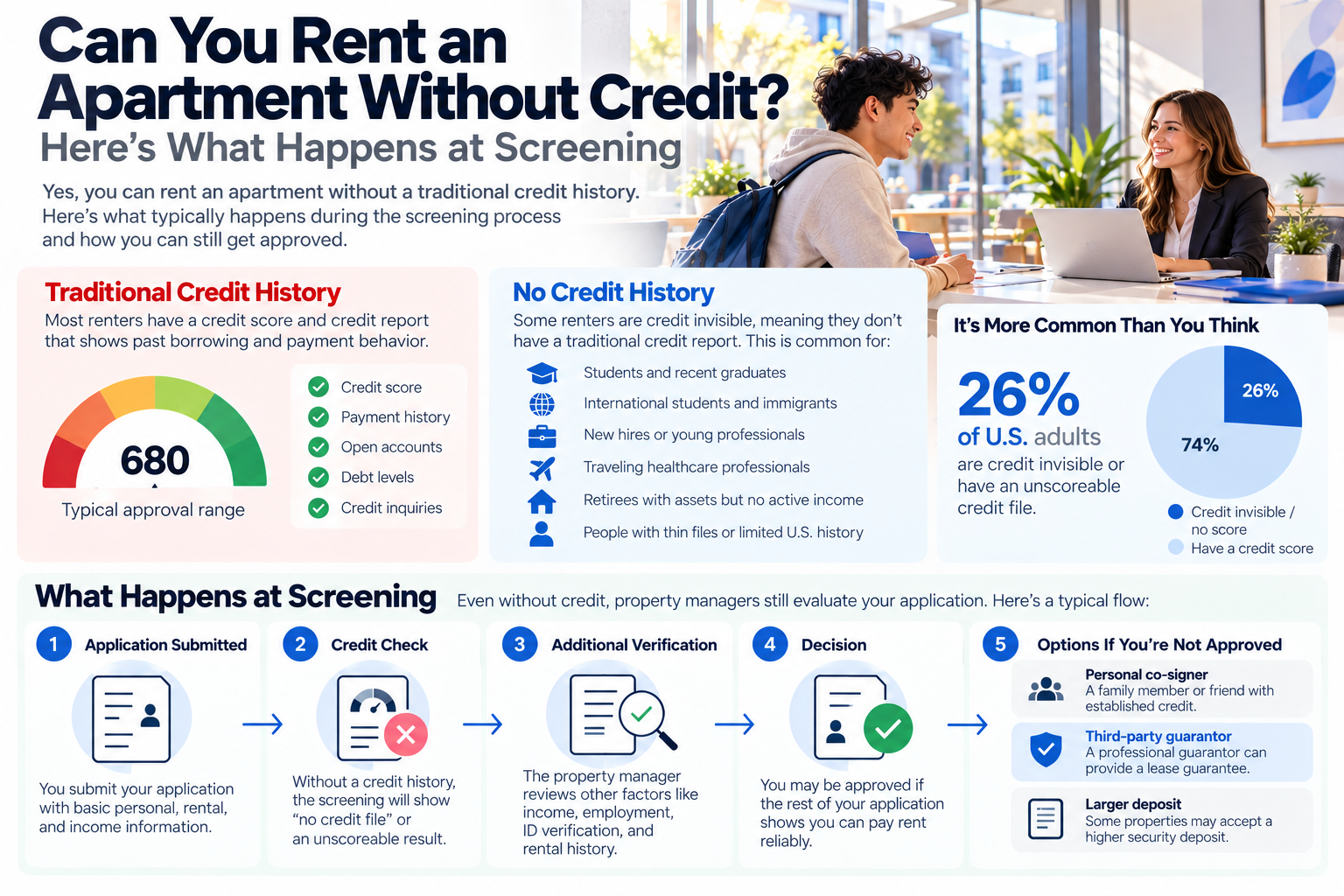
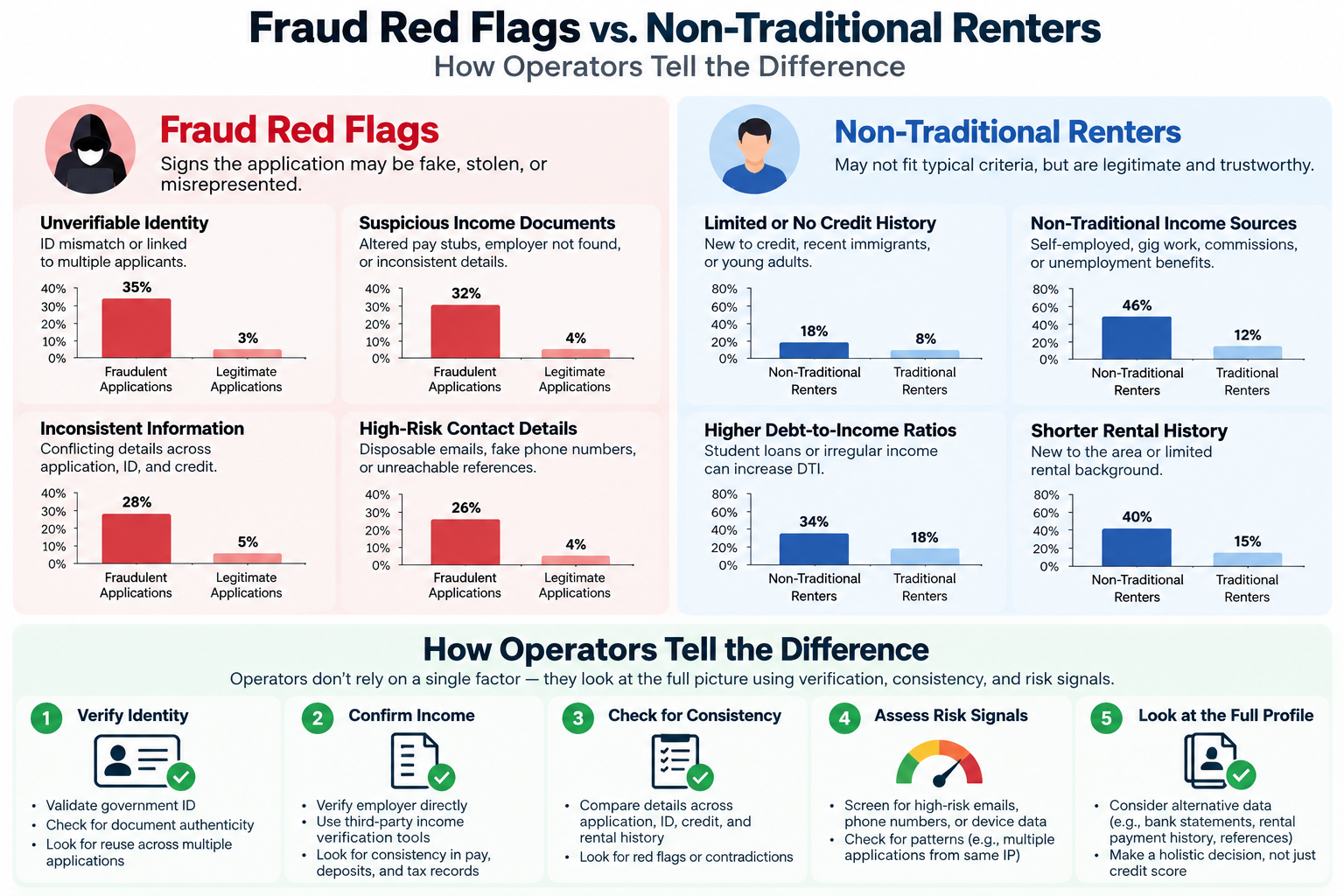
Most operators cannot answer that precisely. What they can observe is the pattern. Applications come in. Some pass standard screening. Others get declined due to thin credit files, income structures that do not map cleanly onto traditional multipliers, or documentation gaps common among international residents, recent graduates, or self-employed workers. Those denials translate directly to vacancy days, concessions to attract the next prospect, and foregone revenue.
The Applicant Pool Is More Diverse Than Traditional Screening Assumes
The U.S. renter base has changed significantly over the past decade. Today's applicant pool increasingly includes people whose creditworthiness does not fit neatly into a FICO score and a pay stub. International students and foreign-trained professionals often lack U.S. credit history entirely. Gig workers and freelancers may earn well above the income threshold on an annualized basis but show irregular monthly deposits. New hires joining companies are fully employed but have not yet received their first paycheck. Retirees often carry substantial assets but show limited monthly income on paper.
Each of these renter types represents real demand. Barriers to homeownership remain historically high in 2026, with a 105% monthly premium to buy versus rent, an estimated shortage of 3.4 million single-family homes, and mortgage rates keeping millions of would-be buyers in the rental market longer than they planned. Many of those renters are financial stable. They simply do not screen well under frameworks built for a different era.
Operators who can serve them without taking on undue risk gain a meaningful competitive edge. Those who cannot are competing for a smaller slice of the market with more concessions per lease.
How Cosign Expands Qualified Approvals Without Expanding Risk
Cosign is a platform that lets property operators approve applicants who fall outside standard credit or income requirements, with Cosign standing behind the lease, while those leases keep Cosign's full financial backing. When a renter is approved through Cosign, the property is covered for up to 12x the monthly rent across claims for unpaid rent or damages, with claims processed within five business days of a documented vacancy.
The product costs operators nothing. Renters pay a one-time fee. The property gets a lease fully backed by Cosign.
That structure does something important for NOI math. It converts approvals that would have otherwise ended in denial into lease revenue, without concessions, without compromising the property's risk profile, and without additional administrative burden. Operators can refer their first resident in under 60 seconds. Average staff training time is approximately 30 minutes.
The performance data across Cosign's portfolio is specific. Asset Living, one of the largest third-party management firms in the country, saw a 10% improvement in applicant-to-lease conversion after implementing Cosign, with an average approval time of 24 hours. Read Property Group added $4M in annual revenue through expanded approvals and an 11-point improvement in conversion rate. Freeman Webb's The Dutton community achieved 61% conversion at lease-up, with $729K in annual revenue attributed to Cosign-enabled approvals and a $6.7M increase in estimated asset value within six months.
These outcomes are not theoretical. They come from operators managing real assets in competitive markets, applying the same risk discipline they always have, with an expanded pool of residents who can now qualify.
What NOI Looks Like When Conversion Improves
The numbers compound quickly. Consider a 300-unit community with an average rent of $1,750 per month running at 91% occupancy. That's 273 occupied units and 27 vacant. At current conditions, filling even 10 of those units through improved conversion adds roughly $210,000 in annual revenue before accounting for reduced concession spend and lower turn costs.
At a conservative 5% cap rate, that occupancy improvement translates to approximately $4.2M in asset value. That is not a rounding error. It is the difference between an asset that is performing and one that is underperforming in an environment where multifamily property values have already declined roughly 28% from their 2022 peak, according to NAHB.
For operators managing stabilized assets who are trying to hold value while the supply cycle works itself out, conversion is the lever most directly within their control.
The Practical Path Forward
Operators looking to protect NOI in a soft rent environment have a clear framework available to them.
First, measure conversion. If you are tracking applications and move-ins but not the gap between them, you are missing the most actionable data in your funnel. Segment by applicant type. Understand where approvals are falling through and whether those declines map to income structure, credit history, or documentation type.
Second, identify which segments you are consistently leaving on the table. International applicants, self-employed renters, and recent graduates are the three most common. Cosign accepts both SSN and ITIN, which expands access for international renters specifically.
Third, implement Cosign at the property level. The referral process takes under a minute. The onboarding is minimal. The coverage tiers are customizable from 3x to 12x monthly rent, giving operators flexibility to calibrate based on their risk tolerance and portfolio composition.
In a market where rent growth is measured in fractions of a percent, occupancy gains measured in percentage points are where the real revenue story is written. Cosign is the most direct path most operators have to that outcome.
See how it works for yourself. Book a demo today at rentwithcosign.co
Frequently Asked Questions
Q: How does Cosign improve multifamily NOI?
A: Cosign allows operators to approve applicants who fall outside standard credit or income requirements, with Cosign taking on the financial responsibility if a resident doesn't pay. By expanding the pool of approvals, operators reduce vacancy days and improve lease conversion rates, both of which directly increase net operating income. The impact compounds when measured across a full portfolio.
Q: What kinds of renters does Cosign help property operators approve?
A: Cosign is designed for renters whose creditworthiness is real but does not fit traditional screening models. That includes international students and professionals without U.S. credit history, self-employed and gig economy workers with variable income, recent graduates starting their first job, new hires who have accepted offers but not yet received their first paycheck, retirees with strong assets but limited monthly income, and solo parents or recently divorced individuals rebuilding their financial profiles. Cosign accepts both SSN and ITIN, which broadens access for international applicants specifically.
Q: Does using Cosign mean reducing screening standards?
A: No. Cosign operates as a separate underwriting layer, not a replacement for your existing screening process. The property maintains its standards. Cosign's approval process evaluates the applicant's ability to pay the one-time guarantor fee and fulfill the lease terms. Cosign stands behind up to 12x monthly rent on every approved lease, meaning operators are in a stronger financial position than they would be on a standard lease with no third party involved, not a weaker one.
Q: How quickly does Cosign process claims after a vacancy?
A: Cosign processes claims within five business days of a documented vacancy. Operators have a 60-day filing window after the unit becomes vacant to submit a claim. Coverage applies to unpaid rent and qualifying damages, with tiers ranging from 3x to 12x monthly rent depending on the coverage option selected at the property level.
Q: What does it cost a multifamily operator to use Cosign?
A: Cosign is free to property operators. Renters pay a one-time fee to secure Cosign's backing. The initial referral takes under 60 seconds to complete, and average staff training time across Cosign's portfolio has been approximately 30 minutes per property team. Operators can configure their preferred coverage tiers and begin approving Cosign-backed applicants the same day.
.avif)
.avif)
.jpeg)
.jpeg)



Let’s boost your occupancy rates


