


.svg)


The Ultimate Guide to Resident Retention for Multifamily Operators in 2026

For multifamily operators, resident retention is one of the most direct levers for stabilizing NOI and reducing the operational drag of continuous re-leasing. Acquiring a new resident costs far more than keeping an existing one, and the gap compounds quickly across a large portfolio.
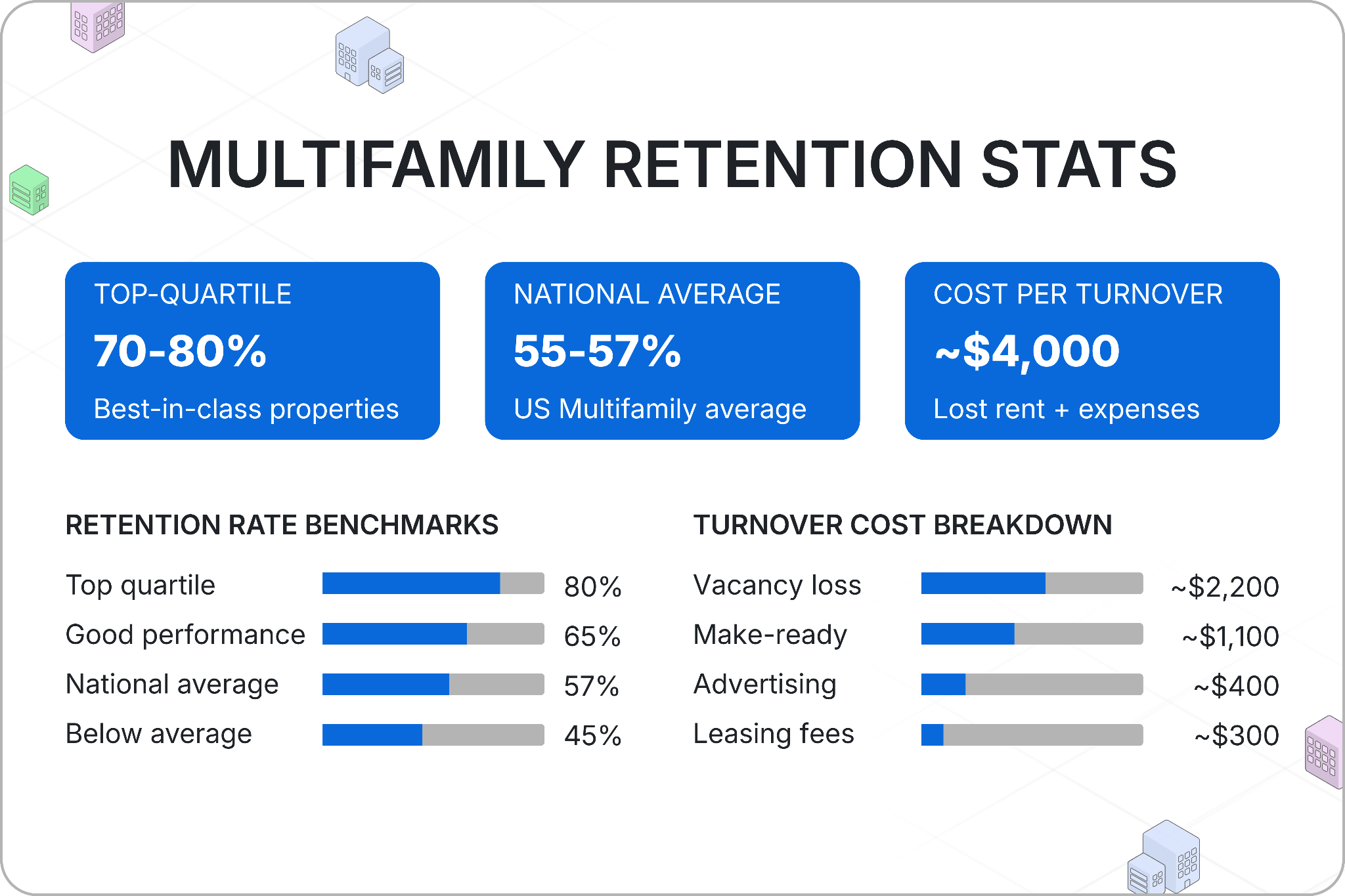
At the same time, the national multifamily retention average sits between 55% and 57%, which means roughly half of all leases are cycling out each year. Top-quartile operators push that rate to 70% to 80%, and the NOI difference is significant.
There is also a persistent gap between what operators assume residents want and what residents actually prioritize. The strategies that actually move retention rates are grounded in fundamentals, not features.
This guide covers what resident retention is, why it matters to your bottom line, and the practical strategies multifamily operators use to move from average to top-quartile performance.
What Is Resident Retention in Multifamily Real Estate?
Resident retention measures the percentage of residents who choose to renew their lease when it expires. It is one of the most telling indicators of how well a property is managed and how satisfied residents are with their living experience.
How Multifamily Operators Calculate Retention Rates
The formula is straightforward: divide the number of leases renewed by the number of leases expiring in a given period, then multiply by 100. For example, if 80 out of 100 expiring leases renew, the retention rate is 80%.
The national average for multifamily resident retention currently sits between 55% and 57%. A rate above 60% is generally considered solid performance. Top-quartile properties with intentional retention programs consistently achieve renewal rates of 70% to 80%.
Controllable vs. Uncontrollable Attrition
Not all turnover is preventable. Some residents leave for reasons outside an operator's control: job relocations, home purchases, family changes, or moves driven by major life events. These represent uncontrollable attrition.
The more important figure is that a substantial portion of multifamily turnover is controllable. Residents who leave because of poor maintenance response times, social isolation, financial friction at renewal, or a general sense that management does not care; those are losses that operators can prevent.
Understanding this distinction matters because it reframes where operators should focus their energy. The strategies in this guide target controllable attrition directly.
Why Resident Retention Matters for Multifamily Operators
The Real Cost of Resident Turnover
Each non-renewal costs a multifamily operator an estimated $3,872 to $4,000. That figure includes lost rent during vacancy, make-ready expenses (cleaning, painting, repairs), advertising costs, and leasing commissions.
On a 200-unit property with average retention, that is a significant recurring expense.
Retaining a resident costs a fraction of replacing one. Investing in a dedicated retention program is one of the most efficient uses of operating budget available to multifamily teams.
How Retention Directly Impacts NOI
Retention is not just a cost-avoidance play. It is a direct driver of Net Operating Income. Moving from average retention to top-quartile performance substantially improves NOI at any portfolio scale, when vacancy loss, turnover costs, and stabilized rental income are factored together.
Predictable occupancy also changes how operators can deploy capital. Properties with stable resident bases spend less time and money on re-leasing cycles and more on the property improvements that make retention easier to sustain over time.
The Social Connection Factor
Financial incentives alone do not explain why residents stay.
Social connection is one of the strongest independent predictors of lease renewal in multifamily research. Residents who feel genuinely connected to their neighbors and community are significantly more likely to renew and more willing to absorb a rent increase to stay in a community they feel part of.
What Renters Actually Want (and Where Operators Miss the Mark)
Before getting into specific strategies, it is worth addressing a documented gap between what operators assume drives retention and what residents actually report valuing.
Survey data shows that multifamily operators tend to believe residents prioritize technology-enabled lifestyles and premium amenities.
Residents consistently rank the following factors at the top:
- maintenance responsiveness
- personal safety
- community cleanliness.
The practical takeaway is that operators who invest heavily in premium features before getting the fundamentals right are misallocating retention dollars. The strategies that follow are ordered with this in mind: fundamentals first, enhancements second.
Top Resident Retention Strategies for Multifamily Operators
1. Prioritize Maintenance Responsiveness
Dissatisfaction with the maintenance process is one of the top reasons residents decide against renewing their lease. When a request goes unacknowledged or unresolved for days, it signals to the resident that management does not value their experience, and that impression sticks at renewal time.
Operators should consider implementing digital work order systems that allow residents to submit and track requests from a phone or portal. The standard to aim for: acknowledge requests within two hours and follow up after completion to confirm the resident is satisfied.
Responsiveness is also a signal. Even when a repair takes time, prompt acknowledgment and proactive communication about status maintain trust in a way that silence cannot recover.
2. Build a 90-Day Onboarding Experience
The decision to renew or not renew is rarely made at lease expiration. Most controllable churn decisions form within the first 90 days of a tenancy, making move-in the most underutilized retention window in multifamily operations.
A structured 90-day onboarding sequence gives operators a framework for that window: a welcome package and neighbor introductions at move-in, personal check-ins at 30 and 60 days, and a satisfaction survey at 90 days. Each touchpoint is an opportunity to resolve friction before it hardens into a decision to leave.
Retention strategy begins at move-in, not 90 days before lease expiration. Operators who treat the two as separate programs leave significant renewal opportunity on the table.
3. Invest in Community Building

Given the data on social connection and renewal likelihood, community programming is one of the highest-ROI retention investments available to operators. A modest budget directed toward events like trivia nights, pet photo contests, and social hours can yield measurable improvement in renewal rates.
Shared on-demand amenities are another mechanism for creating organic resident interaction. These services reduce individual household costs while giving residents recurring reasons to engage with their neighbors.
The goal is not to run elaborate programming. It is to create the conditions under which residents naturally build the social ties that make leaving feel costly.
4. Use Technology to Automate Renewal Workflows and Flag At-Risk Residents
Centralized operations platforms allow operators to automate renewal reminders, track lease expiration timelines across a portfolio, and surface at-risk residents before they make a decision to leave. The goal is to shift retention from a reactive task to a proactive one.
Behavioral signals are the key inputs: declining event attendance, repeated maintenance complaints, and missed or late rent payments. When these patterns appear together, they reliably predict non-renewal weeks or months before the lease expiration conversation begins.
Platforms that surface these signals automatically allow onsite staff to intervene with a check-in rather than a last-minute renewal pitch.
Automation also reduces the administrative burden on leasing teams, freeing them to focus on the high-value resident interactions that technology cannot replace. We have an in-depth article on AI-powered property management tools you can check out to help with this.
5. Improve Package Management and Security
Package management failures erode resident trust faster than operators typically recognize. Manual logging creates backlogs, lost packages generate complaints, and the cumulative friction of a poorly run system adds up to a quiet but consistent driver of dissatisfaction.
Smart locker systems provide secure, 24/7 self-service delivery access that removes the friction entirely. For residents who receive regular deliveries, this is a tangible quality-of-life improvement that is easy to attribute to management.
Security more broadly, including lighting, access control, and surveillance, consistently ranks among residents' top priorities. These are not amenity upgrades. They are baseline expectations, and falling short of them is a predictable source of controllable churn.
6. Offer Flexible Lease Terms and Resident Rewards
Rigid lease structures push residents out even when they are otherwise satisfied. Offering lease lengths of 6, 12, or 18 months reduces forced non-renewals driven by life circumstances rather than dissatisfaction with the property or management.
Resident rewards programs tied to on-time payment and lease renewal create positive reinforcement loops that make staying feel like the better financial decision.
Credit reporting also has an enormous effect on residents’ likelihood to pay on time, which further increases retention. Nearly 80% of renters say they are more likely to pay on time when their payments are reported to credit reporting agencies, making rent reporting an effective stickiness tool for operators who implement it.
Proactive renewal outreach beginning 90 to 120 days before lease expiration gives residents adequate time to make a considered decision. Last-minute renewal conversations rarely go well for either side.
How Better Qualification Reduces Controllable Turnover Before It Starts
Most retention strategies focus on what happens after a resident moves in. But a meaningful category of controllable turnover begins upstream, at the qualification stage, before a resident ever signs a lease.
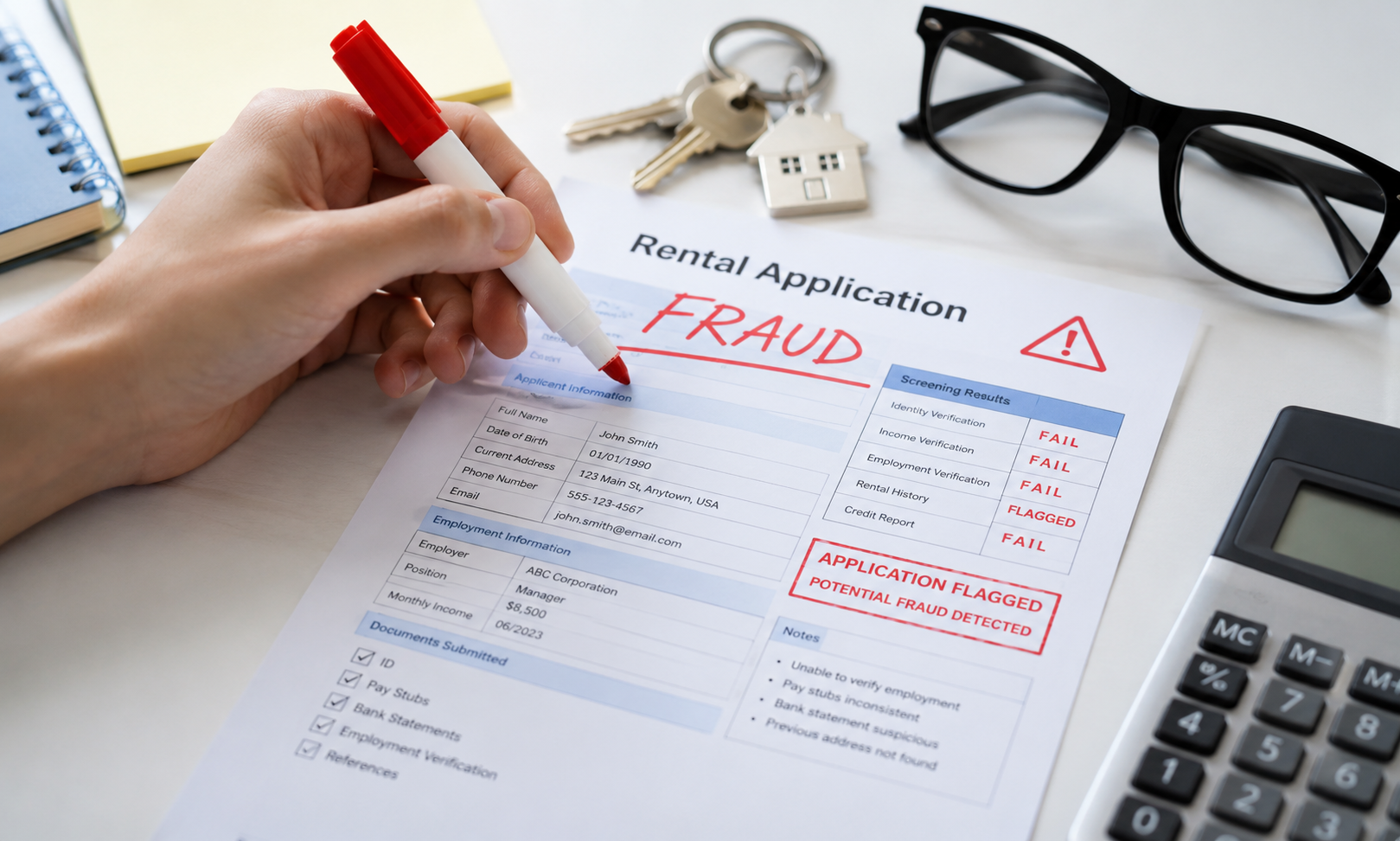
Financial friction at renewal is one of the top controllable churn drivers. When a resident narrowly passes initial screening but struggles with a rent increase at renewal, or fails re-screening due to income changes, the result is a non-renewal that no amount of community events or maintenance responsiveness could have prevented. The placement decision created the problem.
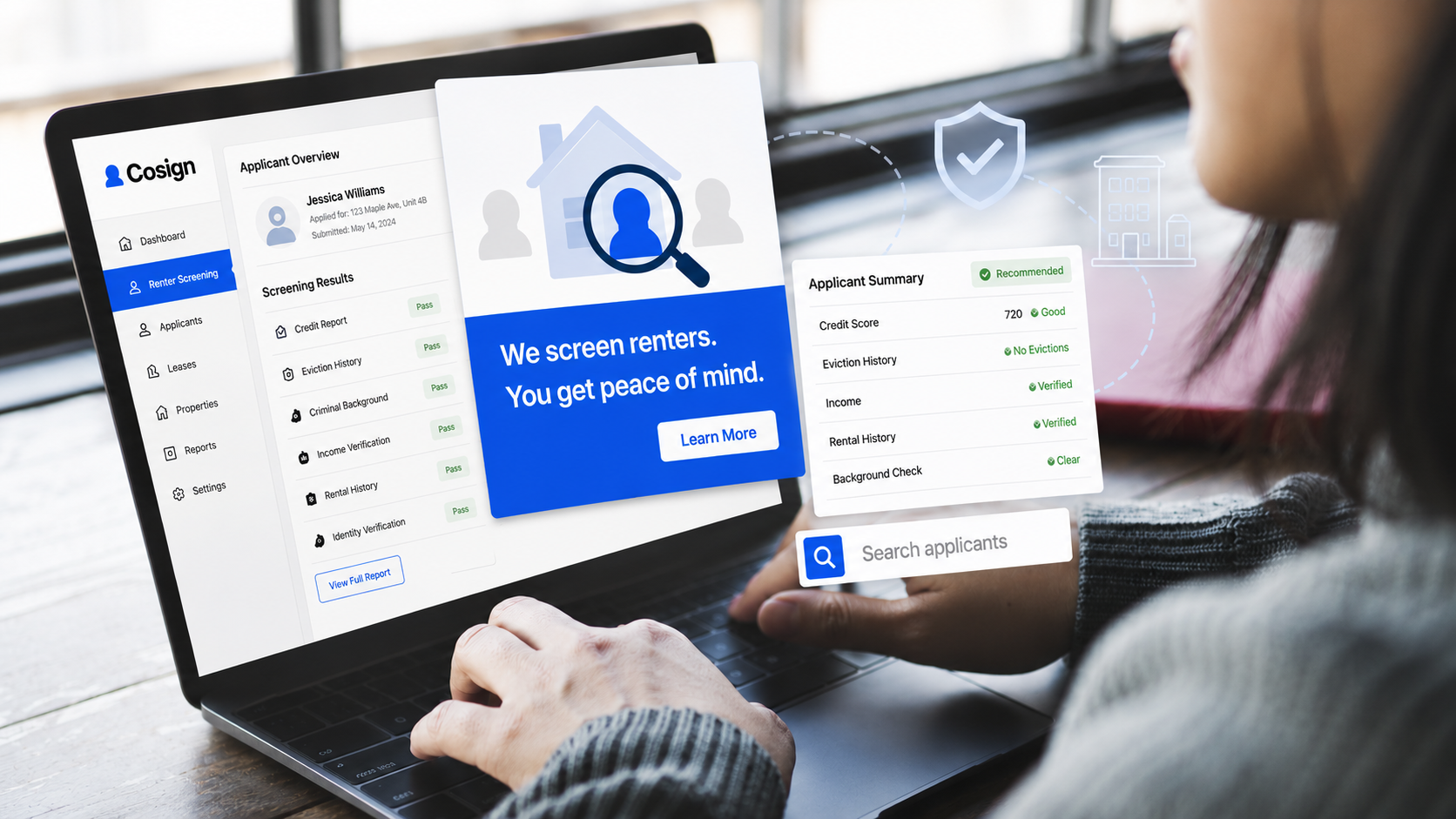
This is where rent guarantor solutions like Cosign enter the picture.
Cosign acts as a guarantor for qualified applicants who narrowly miss standard income or credit thresholds, giving operators the ability to place residents who are likely to pay and stay, without taking on undue financial risk.
Operators who address qualification upstream reduce a class of churn that downstream retention programs cannot touch.
The upstream-downstream distinction matters for how operators think about their retention budget. Money spent on community programming and onboarding is well spent. But if the qualification pipeline is placing residents who are financially stretched from day one, the retention program is working against a structural disadvantage it did not create.
Using Data to Sustain Retention Over Time
Resident Surveys and Satisfaction Scoring
Regular surveying, quarterly or following a maintenance interaction, gives operators a running read on resident sentiment before it becomes a non-renewal.
Resident Satisfaction Scores (Rsat) and Net Promoter Scores (rNPS) provide structured benchmarks that make trends visible over time.
Collecting feedback is only half the equation.
Residents who see their input lead to visible changes develop a sense of investment in the community that translates directly into renewal intent. Surveys that go nowhere do the opposite: they signal that management is going through the motions.
Predictive Analytics and At-Risk Identification
The most effective retention interventions happen before a resident has mentally checked out.
Predictive analytics platforms allow operators to monitor behavioral signals at the portfolio level: declining event attendance, repeated maintenance complaints, payment irregularities, and changes in portal activity.
When these signals cluster around a specific resident, a proactive check-in from a property manager or leasing agent can surface and resolve an issue that would otherwise result in a non-renewal. This kind of early intervention is only possible when operators are monitoring the right data consistently.
Building a Retention-First Operation
Resident retention is the most cost-effective profitability lever available to multifamily operators. The math is straightforward: retaining a resident costs a fraction of replacing one, and the NOI impact of moving from average to top-quartile retention is substantial at any portfolio scale.
The operators who consistently achieve top-quartile retention share a common approach.
They get the fundamentals right first: maintenance responsiveness, safety, and communication.
They build community intentionally, with modest but consistent investment.
They use technology to automate what can be automated and to surface the signals that allow for early intervention.
And they think about retention as beginning at qualification, not at lease expiration.
For operators looking to reduce controllable turnover at the qualification stage, Cosign helps place residents who are more likely to pay and stay by acting as a rent guarantor for qualified applicants who narrowly miss standard thresholds.
Frequently Asked Questions
What is a good resident retention rate for multifamily properties?
The national multifamily average sits between 55% and 57%. A rate above 60% is generally considered solid performance. Top-quartile properties with active retention programs consistently achieve renewal rates of 70% to 80%.
How much does resident turnover cost multifamily operators?
Each non-renewal costs an estimated $3,872 to $4,000 per unit, covering make-ready expenses, vacancy loss, advertising, and leasing commissions.
What are the main reasons apartment residents do not renew?
The leading controllable reasons include poor maintenance responsiveness, safety concerns, and rent increases. Uncontrollable reasons include job relocation and home purchase.
How can technology help with multifamily resident retention?
Digital portals and automated renewal workflows reduce friction and ensure no lease expiration goes unaddressed. Predictive analytics platforms monitor behavioral signals to surface at-risk residents early. Together, these tools free up onsite staff for the high-value interactions that drive renewal decisions.
What is the 1% rule in multifamily, and how does it relate to retention?
The 1% rule is a property acquisition metric: monthly rent should equal at least 1% of the purchase price. It is a purchase-evaluation tool, not a retention metric. Operators focused on retention performance should track renewal rates, turnover costs, and NOI impact instead.
What is the 30% rule for apartments?
The 30% rule is a renter affordability guideline: households should spend no more than 30% of gross income on rent. For operators, understanding where residents sit relative to this threshold can inform renewal pricing decisions and help identify residents at risk of financial-friction churn before a non-renewal occurs.
.avif)
.avif)
.png)
.png)


Let’s boost your occupancy rates


