


.svg)


How to Fill Out an Apartment Application and Get Approved

Knowing how to fill out an apartment application correctly is one of the biggest factors separating renters who move in quickly from those who start over. The process is competitive, and landlords make decisions fast.
A complete, accurate, well-prepared application signals that you are a reliable tenant before you ever meet your future landlord.
This guide covers everything you need: the documents to gather, a step-by-step walkthrough of the application itself, what to expect after you submit, and what to do if you don't qualify on your own. Over 40% of renters are denied their first-choice apartment due to qualification barriers. Understanding the full process is what puts you ahead.
Gather These Documents Before You Fill Out a Rental Application
The fastest way to lose an apartment is to be unprepared when the moment arrives. Landlords often approve the first qualified applicant, not the best one. Having your documents ready before you tour means you can apply the same day.
Government-Issued Photo ID
Every application requires a valid government-issued photo ID. A driver's license, state ID, or passport all work. If you are not a U.S. citizen, a green card or passport with valid visa documentation is typically accepted.
Proof of Income
Landlords generally look for a monthly gross income of at least three times the monthly rent. Standard documentation includes your two most recent pay stubs, last two months of bank statements, or your most recent W-2 or tax return.
If you are self-employed, a freelancer, or work on contract, come prepared with additional documentation. 1099 forms, client contracts, or a letter from an accountant help demonstrate financial stability when traditional pay stubs are not available.
In some cases, you might have a job offer letter, but have not yet received a paycheck, which is a common stumbling block. If this is your situation, gather whatever documentation you have and be ready to explain your income picture clearly.
Rental History and References
Prepare a list of your previous addresses going back two to three years, along with the move-in and move-out dates, monthly rent amounts, and landlord contact information for each. Landlords will have the option to call and verify.
A landlord recommendation letter, which is a written statement from a previous landlord confirming your payment history and lease compliance, can significantly strengthen a borderline application. If you left your last rental on good terms, it is worth asking for one before you start your search.
Pet and Vehicle Information
If you have a pet, prepare what many landlords call a "pet resume": breed, weight, age, and proof of up-to-date vaccinations. Some applications also ask for proof of pet insurance.
If the building has parking, you will need your vehicle's make, model, year, license plate number, and proof of auto insurance. Some landlords require insurance documentation to assign a parking space.
Know Your Upfront Costs Before You Apply
Before submitting a single application, understand the full financial picture of moving in. Most renters budget for first month's rent and stop there. The real number is typically much higher.
Standard upfront costs include:
- Application fee: $25–$100 per applicant, non-refundable in most cases
- Security deposit: Usually one to two months' rent
- First and last month's rent: Many landlords require both upfront
- Pet deposit: A separate, often non-refundable fee if you have a pet
- Renter's insurance: Required by many landlords before move-in; protects your personal belongings from theft, fire, and other unexpected events
Knowing these numbers in advance helps you avoid surprises and shows landlords you are financially ready to commit.
Step-by-Step Guide to Filling Out an Apartment Application

Once your documents are organized, the application itself is straightforward. The key is accuracy. Errors or omissions, even small ones, can delay approval or trigger an automatic denial.
Step 1: Enter Your Personal and Contact Information
Start with the basics: your full legal name, current address, phone number, and email address. Most applications also ask for an emergency contact, typically a family member or close friend, including their name, relationship, and phone number.
Step 2: Disclose Your Reason for Moving
Many applications include a field asking why you are leaving your current home. Keep your answer brief and factual. Relocating for work, needing more space, or seeking a shorter commute are all straightforward answers. Avoid anything that raises questions about your previous tenancy.
Step 3: List Co-Applicants and Roommates
Every adult over the age of 18 who will live in the unit must submit a separate application. If you are applying with a partner or roommate, coordinate early so both applications are submitted at the same time. A delay from one applicant can hold up the entire review.
Step 4: Authorize the Background and Credit Check
You will be asked to provide your Social Security number and sign a consent form authorizing a credit check and background check. Landlords use these to review your credit score, eviction history, and criminal record.
Most landlords look for a credit score of 620 to 700 or higher, though requirements vary. A background check typically covers the last seven years. If anything in your history may raise a question, it is better to address it proactively in a cover letter than to let a landlord discover it without context.
Step 5: Pay the Application Fee
Application fees typically run between $25 and $100 per applicant and are non-refundable. The fee covers the cost of running your screening reports.
Note that application fee rules vary by state. In California, New York, and Minnesota, fees are capped at the actual cost of the credit and background check. In Massachusetts and Vermont, landlords are prohibited from charging application fees altogether. Know the rules in your state before you apply.
Step 6: Review, Sign, and Submit
Before you submit, read every field. Confirm your name is spelled exactly as it appears on your ID. Check that addresses, dates, and contact information are accurate and up to date. A single missing field can slow down your approval by days.
Applications are submitted either online or in person, depending on the property. Online applications are increasingly the norm, especially at larger apartment communities. If you apply online, follow up with an email to the leasing office to confirm receipt.
What Happens After You Submit Your Application
Most renters focus entirely on the application itself and are caught off guard by what comes next. Understanding the post-submission process helps you stay prepared and move quickly when you are approved.
How Long Does Approval Take?
Most landlords respond within 24 to 72 hours. Out-of-state applicants or those with more complex backgrounds may wait up to a week while employment history and references are verified. You can help speed things up by notifying your references that they may receive a call and ensuring all documents are accurate and current.
Approved? What to Expect Next
An approved application is not the same as a signed lease. Before you move in, you will need to:
- Review the lease carefully: Confirm your move-in date, monthly rent amount, parking fees, pet policy, subletting rules, and the cost of breaking the lease early. Ask questions about anything that is not clear before you sign.
- Pay your upfront deposits: Most landlords require the security deposit and first month's rent, and sometimes last month's rent, before handing over keys. Have certified funds ready.
- Obtain renter's insurance if required: Many landlords require proof of an active renter's insurance policy before move-in. Renter's insurance covers your personal belongings. It is separate from a guarantor service like Cosign, which helps you qualify for the lease in the first place, not to insure the contents of your apartment.
- Sign the lease: Every adult listed on the application must sign. Keep a copy for your records.
Following Up on a Pending Application
If you have not heard back within 48 hours, a brief, polite follow-up is appropriate. A short email or phone call to the leasing office demonstrates genuine interest and keeps your application on the leasing team's radar. It also gives you a chance to confirm that everything was received and nothing is missing.
How to Fill Out an Application With No Rental History or Bad Credit

A thin credit file, limited rental history, or non-traditional income does not mean you cannot get approved. It means you need to prepare differently.
The Co-Signer vs. Guarantor Distinction
These terms are often used interchangeably, but they mean different things, and the distinction matters.
A co-applicant is someone who will live in the unit with you. Their income and credit are evaluated alongside yours, and they sign the lease as a tenant.
A personal co-signer does not typically live in the unit. They take on legal and financial liability for the lease if you default. Most landlords require a personal co-signer to earn four to five times the monthly rent and have strong credit. Not everyone has access to a family member or friend who can meet that bar.
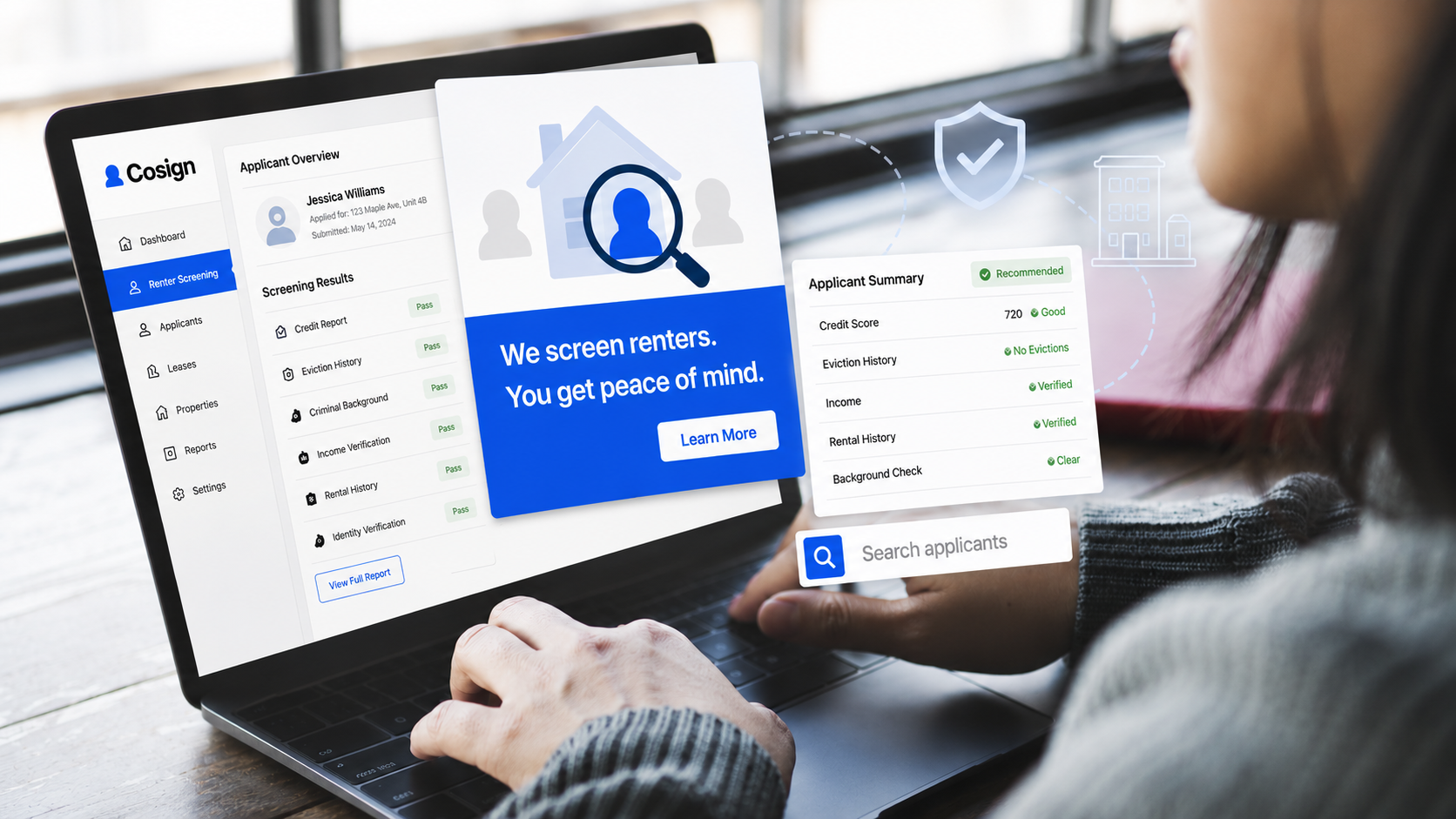
A guarantor is a third party, either an individual or a professional service, who is legally responsible for rent obligations if the tenant defaults. A professional guarantor like Cosign serves the same function as a personal co-signer, but without requiring you to involve a family member. Cosign evaluates your full financial picture, not just your credit score, and steps in as your guarantor so landlords have the security they need to approve your application.
Who Cosign Helps
Cosign was built specifically for renters who fall just outside traditional qualification criteria. That includes:
- International residents without a U.S. credit history
- Recent graduates and young professionals with limited credit
- Self-employed or freelance workers with variable income
- Retirees with strong assets but no active employment income
- Renters who have accepted a job offer but have not yet received their first paycheck
If any of these describe your situation, a professional guarantor service may be what makes the difference between an approval and a denial. We've written a full guide on the best guarantor services available on the market right now.
Applying When Moving Out of a Family Home
If you are moving out of your parents' home for the first time, list your current address and your parents as your landlord reference. Focus your application on your employment and income documentation to demonstrate that you can independently cover rent.
Submitting a Renter's Cover Letter
If you have a red flag in your history, like a past eviction, a period of poor credit, or a gap in employment, address it directly in a short cover letter attached to your application. Explain the circumstances honestly and describe what has changed. Landlords are more likely to work with an applicant who is upfront than one who lets the background check speak for itself.
What to Do If Your Application Is Denied
Denial is more common than most renters expect. Understanding why it happened and what comes next is how you turn a setback into a signed lease.
Common Reasons for Denial
The most frequent causes of a rental application rejection include insufficient income, low or thin credit history, an eviction record, an issue flagged in the criminal background check, an incomplete or inaccurate application, or pet restrictions at the specific property.
Your Options After a Denial
A denial is not the end of your search. Consider these next steps:
- Ask for the reason in writing: In many states, landlords are required to provide an adverse action notice explaining the basis for their decision. This helps you understand exactly what to address before your next application.
- Add a qualified guarantor: A professional guarantor service like Cosign can step in to bridge the gap between your current profile and a landlord's qualification requirements.
- Offer additional financial security: A larger security deposit or an offer to prepay additional months of rent can reduce a landlord's perceived risk.
- Keep applying in parallel: Competitive rental markets move quickly. Do not pause your search while waiting on a single decision.
- Work on your credit if timing allows: Even a modest score increase can shift you from denial to approval at many properties.
Final Tips for a Stronger Apartment Application
Be Honest and Transparent
Never misrepresent information on a rental application. Background checks are thorough, and discrepancies between what you report and what a landlord discovers are grounds for immediate rejection. Being upfront about past issues, paired with a clear explanation of your current situation, is a stronger strategy than hoping nothing surfaces.
Treat It Like a Job Application
Presentation signals professionalism. Use proper capitalization. Check spelling and grammar. Make sure every field is legible and complete. A sloppy application raises questions before a landlord has even seen your credit report.
Apply to Multiple Properties at Once
Especially in competitive markets, do not wait for the outcome of one application before submitting others. Most application fees are $25–$100, a reasonable cost compared to losing an apartment while waiting on a decision that does not come through.
Communicate and Follow Up
After submitting, send a brief follow-up within 48 hours. After approval, respond promptly to every request from the leasing office. Speed and responsiveness signal reliability.
Conclusion
Knowing how to fill out an apartment application thoroughly and accurately is the foundation of a successful rental search. Gather your documents before you need them. Complete every field with care. Understand the costs ahead of time. Review the lease before you sign.
And if your credit, income, or rental history falls short of what a landlord is looking for, that does not have to be the end of the road. Tools like Cosign exist specifically for that moment, to step in as your guarantor, back your application, and help you get approved for the apartment you want.
Read our renters’ guide to understand what guarantor services are and how they help you qualify for an apartment.
Frequently Asked Questions
How long does the rental application process take? Most applications are processed within 24 to 72 hours. Out-of-state applicants or those with more complex backgrounds may wait up to a week while employment and references are verified.
Why do rental applications ask for my Social Security number? Your SSN is required to run a credit check and a criminal background check. It allows the landlord to verify your identity and assess your financial history. You should not be required to provide a physical copy of your Social Security card: providing the number verbally or entering it into a secure online form is sufficient.
What is a good credit score for renting an apartment? Most landlords look for a credit score of 620 to 700 or higher, though requirements vary by property type and market. A score below 620 does not automatically disqualify you, a co-signer, professional guarantor, or larger security deposit may offset the risk.
What is a credit reference on a rental application? A credit reference is documentation that describes your credit history and demonstrates your ability to make consistent payments. The most common form is a credit report. Bank statements, asset documentation, or a character reference from a financial institution can also serve as credit references.
What is the difference between a co-signer and a guarantor? A co-signer often has rights tied to the lease and may be considered a co-tenant. A guarantor carries financial liability only, meaning they are legally responsible for rent obligations if you default, but they do not live in the unit and hold no tenancy rights. Professional guarantor services like Cosign operate as guarantors, not co-signers.
What happens if my rental application is denied? Common causes include insufficient income, poor or thin credit, an eviction record, or an incomplete application. After a denial, you can request a written explanation, add a professional guarantor to your next application, offer a larger security deposit, or apply to other properties. Many renters who are initially denied are approved at the same property or a comparable one with the right support in place.
.avif)
.avif)
.png)

.png)



Let’s boost your occupancy rates


