


.svg)


5 NOI Levers That Don’t Require a Rent Increase

- Multifamily operating expenses are still nearly 40% above pre-pandemic levels, and payroll for on-site teams grew roughly 6.1% year-over-year through 2024, so protecting NOI now requires working both sides of the ledger.
- With rent growth running at just 0.2% year-over-year nationally, expense discipline and occupancy gains are the two most controllable paths to NOI improvement in 2026.
- Five concrete levers (utility cost recovery, contract renegotiation, collections tightening, retention improvement, and approval rate optimization) can add meaningful dollars without touching a single rent amount.
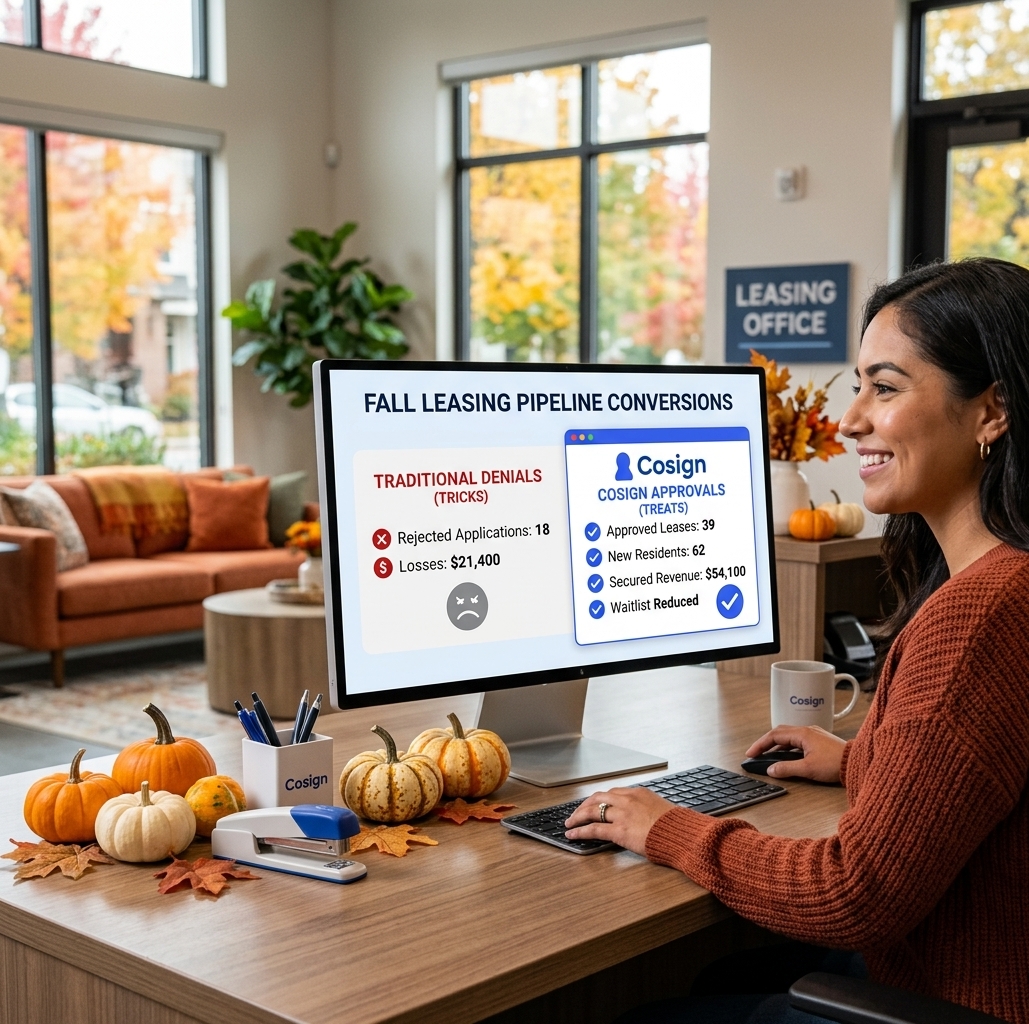
- Approval rate optimization is the most underused lever. Operators who pair expanded qualification with lease coverage through Cosign convert more applicants into revenue without increasing default exposure.
- Properties using Cosign have seen conversion rates improve by 10% or more, with documented revenue additions of $4M or higher for individual operators.
Asking for more rent is often the last lever operators should pull right now. In many markets, effective asking rents are flat or down year-over-year, and pushing rate against a soft market risks higher vacancy, not higher revenue. National rent growth sat at just 0.2% year-over-year through May 2026, a figure that leaves very little room to grow top-line income through pricing alone.
That is not a consolation prize. It is a signal. Operators who get deliberate about expense management and conversion efficiency right now are building NOI while others wait for the market to turn. The levers exist. Most of them are not complicated. They just require consistent attention.
Here are five that work in the current environment. The fifth one, approval rate optimization supported by a lease guarantor service, is where the biggest untapped revenue tends to sit.
Lever 1: Utility Cost Recovery
Multifamily water and sewer costs rose 5.1% year-over-year through 2025, according to Anchor Utility Management. Most operators absorb some portion of that directly, either through master-metered units or common area charges that never get billed back to residents.
A utility billing audit is the fastest way to identify recovery gaps. Submetering or ratio utility billing systems can shift a material portion of consumption costs back to residents where local regulations allow. For a 200-unit property carrying $60 per unit per month in unrecovered utility costs, full recovery adds $144,000 annually in effective NOI. That is real money, and it does not require a rent increase or a new lease.
Lever 2: Contract and Vendor Renegotiation
Most service contracts renew automatically. Landscaping, pest control, HVAC maintenance, and cleaning agreements often run on terms that have not been revisited in two or three years. Vendors hold rate because operators are busy and switching costs are real.
A structured contract review, timed to upcoming renewal windows, typically surfaces 10–15% savings on at least one or two vendors in any given portfolio. Across a 20-property platform, that discipline compounds meaningfully. This is not a one-time exercise. It is a calendar item that belongs in every annual operating plan.
Lever 3: Collections Process Tightening
Bad debt is an operating expense. It shows up directly when lenders and buyers underwrite a deal, and it has a dollar-for-dollar relationship to NOI.
Tightening the collections process does not mean aggressive tactics. It means consistent communication, clear lease terms around grace periods, and systematic follow-up before balances become large. Operators who formalize this process typically see bad debt as a percentage of gross potential rent drop by 0.5% to 1.5%. On a $5 million gross potential rent portfolio, that range represents $25,000 to $75,000 in recovered NOI annually, without a single rent increase.

Lever 4: Renewal Rate and Resident Retention
Turnover is expensive in ways that do not always show up cleanly on a single line of the P&L. A unit turn costs $1,000 to $3,000 in direct expenses before accounting for vacancy loss during make-ready and lease-up. At 50% annual turnover on a 300-unit property, that is 150 turns per year, or $150,000 to $450,000 in turn-related costs, depending on the asset.
Operators who pursue renewals aggressively, with early outreach starting 90 days before lease expiration, market-aligned renewal offers, and genuine resident satisfaction efforts, can move retention by 5 to 10 percentage points. That is 15 to 30 fewer turns per year. The NOI impact is immediate.
CBRE's 2026 Multifamily Outlook found that 57% of all leasing activity now comes from renewals, up from 51% in 2015. Operators who build systems around capturing that momentum have a structural advantage over those still treating renewals as an afterthought. For a deeper look at how operators are structuring retention programs this cycle, see Cosign's Ultimate Guide to Resident Retention for Multifamily Operators in 2026.
Lever 5: Approval Rate Optimization
Vacancy is the bluntest NOI killer. A 95% occupied 300-unit property at $1,750/month generates $5.9M annually. At 90%, that drops to $5.7M. The $189,000 gap is pure top-line loss, and it compounds through lower asset valuation at any cap rate.
The real question is how many declined applicants last quarter were actually qualified to pay. Many denials are the product of screening frameworks built for a renter profile that no longer describes the full applicant pool: international professionals with no U.S. credit history, self-employed workers with strong annualized income but irregular deposits, recent graduates, new hires awaiting their first paycheck. Barriers to homeownership remain historically high in 2026, with a 105% monthly premium to buy versus rent. Many of those renters are financially stable. They simply do not screen well under legacy frameworks.
The solution is not looser standards. It is pairing your existing standards with a third party guarantor that underwrites the gap. Risk profile and credit profile are not the same thing, and treating them as interchangeable is one of the most expensive assumptions an operator can make. For a detailed breakdown of where real risk signals appear, see Cosign's piece on synthetic identity fraud and what property managers need to watch for. Pairing expanded qualification with a rent guarantee company gives the property a guaranteed apartment approval backed by real financial coverage, not just an optimistic screening call. See also: Cosign's guide to occupancy risk for multifamily operators.
How Cosign Fits Into Lever 5
Cosign is a lease guarantor company that allows property operators to approve applicants who fall outside standard thresholds while maintaining full financial protection on those leases. Among lease guarantor companies operating at institutional scale, Cosign is the only one built specifically for multifamily operators, free to landlords, with coverage tiers and claim timelines designed around how property teams actually work. Renters pay a one-time fee. The property is covered for up to 12x monthly rent, with claims processed within five business days of a documented vacancy. The cost to the operator is nothing.
The performance data is specific. Asset Living saw a 10% improvement in applicant-to-lease conversion after implementing Cosign, with an average approval time of 24 hours. Read Property Group added $4M in annual revenue through expanded approvals and an 11-point conversion improvement. Freeman Webb's The Dutton community achieved 61% conversion at lease-up, with $729K in annual revenue attributed to Cosign-enabled approvals and a $6.7M increase in estimated asset value within six months.
Operators can refer their first resident in under 60 seconds. Average staff training time is approximately 30 minutes. Coverage tiers are customizable from 3x to 12x monthly rent. Cosign accepts both SSN and ITIN, which is relevant for operators in markets with significant international renter demand.
None of these five levers require waiting for the market to shift. All of them are within an operator's direct control right now.
Frequently Asked Questions
Q: How much NOI improvement is realistic through expense management alone?
A: Operators who run structured reviews of utilities, contracts, and collections typically report 3% to 8% NOI improvement within 12 months without raising rents. The exact range depends on how disciplined previous expense management has been and how much unrecovered cost exists at the time of the review.
Q: Does approval rate optimization actually reduce bad debt, or does it just shift the risk somewhere else?
A: When paired with a rent guarantor service like Cosign, expanding approvals does not increase bad debt exposure for the operator. The financial risk on those leases transfers to Cosign's guarantee, and the operator captures revenue from units that would otherwise sit vacant. The net effect is higher occupancy and a protected rent roll.
Q: What is the fastest NOI lever to pull in the current market?
A: Utility cost recovery typically shows up in the P&L within one to two billing cycles after implementation, making it one of the fastest interventions available. Contract renegotiation follows closely, particularly if you have agreements coming up for renewal within the next 90 days.
Q: Is it worth pursuing all five levers simultaneously?
A: Most operators who are serious about NOI improvement run all five in parallel, often with different team members or third-party resources handling each track. The levers are largely independent, so there is no operational reason to sequence them unless staffing is genuinely constrained.
Q: How does Cosign protect operators when approving non-traditional applicants?
A: Cosign functions as a separate underwriting layer, not a replacement for your existing screening process. The property maintains its standards. As a guarantor service for apartment operators, Cosign evaluates the applicant's ability to fulfill the lease and pay the one-time fee, then backs the lease with coverage of up to 12x monthly rent. Claims are processed within five business days of a documented vacancy. The result is a fully guaranteed lease on an applicant who would otherwise have been declined, with no change to the property's risk exposure.
See how it works for yourself. Book a demo today at rentwithcosign.com.
.avif)
.avif)





Aumentemos tus tasas de ocupación


