


How to Find Where Your Leasing Funnel Is Losing Applicants

A funnel identifies where to investigate
A property can receive plenty of inquiries and still miss its leasing goals. The gap may happen before a tour, after a tour, during application review, or after a conditional result. Looking only at total leads or signed leases does not show where the process is losing momentum.
A leasing funnel audit gives operators a shared picture of those handoffs. It works best as a way to identify which stage needs attention and test whether a change improves the result, rather than as a scorecard for individual consultants.
Define the stages before counting
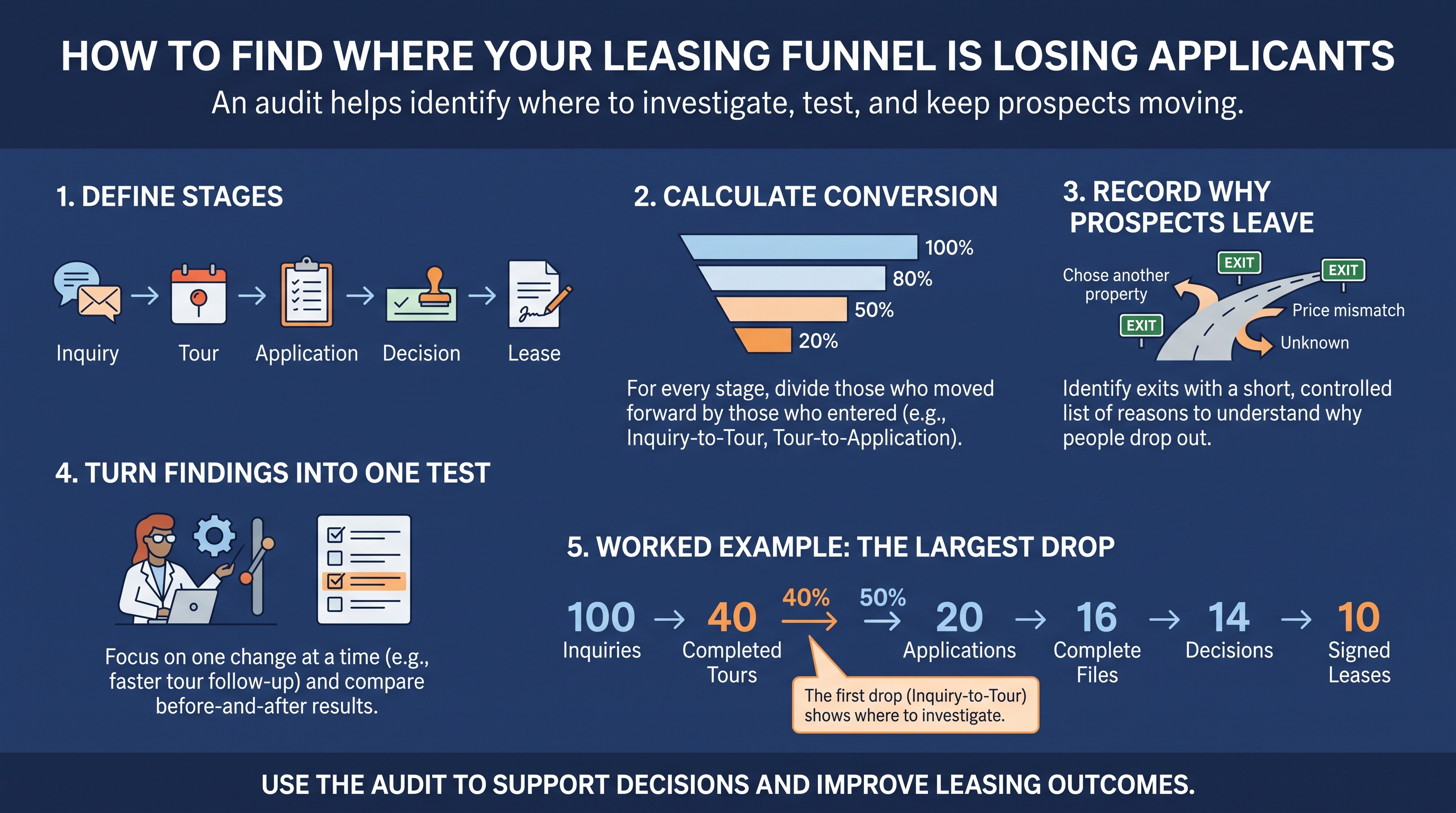
Use stages that match the property's actual workflow. A practical starting point is inquiry, scheduled tour, completed tour, submitted application, complete application, decision, and signed lease. Write down what qualifies a prospect to enter and leave each stage. If one community counts a virtual tour as a tour and another does not, their conversion rates will not be comparable.
Choose a time window and apply it consistently. A prospect who inquires late in the month may not sign until the next month, so a simple monthly count can make the funnel look worse or better than it is. Where possible, compare cohorts based on when the prospect entered the pipeline.
Calculate conversion between each stage
For every stage, divide the number that moved forward by the number that entered it. Track inquiry-to-tour, tour-to-application, application-to-decision, and decision-to-lease conversion separately. Include the count behind each rate so a small sample does not get mistaken for a stable trend.
Break the results down only where the data is reliable and the comparison is useful. Lead source, floor plan, property, and application outcome can reveal patterns. Avoid treating demographic information as a marketing or screening shortcut; apply the company's policies and legal guidance to any analysis involving protected classes.
Record why prospects leave
The funnel shows where people exit; a clear loss reason helps explain why. Use a short, controlled list such as choosing another property, timing changed, no response, unit unavailable, application incomplete, did not meet criteria, or price mismatch. Let staff add a note when none of the options fits.
Do not force a reason when the team does not know. "Unknown" is more accurate than a guess and can itself point to a follow-up gap. Review a sample of notes with the leasing team to see whether the categories are useful and whether follow-up would have been appropriate.
Turn the findings into one test
If many prospects tour but do not apply, review how the team explains the next step and how quickly follow-up happens. If applications stall before a decision, look at missing documents, review ownership, and internal handoffs. If decisions are delivered but leases are not signed, examine timing, clarity, and the options available after the outcome.
Choose one change, assign an owner, and compare the same funnel measures after a defined period. A test could be a same-day tour follow-up or a daily review of incomplete applications. Changing several steps at once makes it harder to tell what helped.
Use the audit to support decisions
A steady funnel review helps onsite teams and owners focus on the point where a change can make a difference. It also shows whether the problem is lead volume, process friction, or the gap between an applicant's profile and the property's written criteria.
Worked example: find the largest visible drop
For one hypothetical cohort, with every number invented for illustration, a property might see 100 inquiries, 40 completed tours, 20 applications, 16 complete files, 14 decisions, and 10 signed leases, which gives hypothetical stage conversion rates of 40%, 50%, 80%, 87.5%, and about 71% respectively. In this hypothetical, the low inquiry to tour rate is the first place to investigate, although it doesn't by itself show that follow-up caused the loss.
Check contact timing, lead source, availability, and a sample of notes before choosing a test. The funnel points to the next question; the notes and follow-up help explain why prospects left. Investigate before changing the process, then check whether the next cohort moves forward.
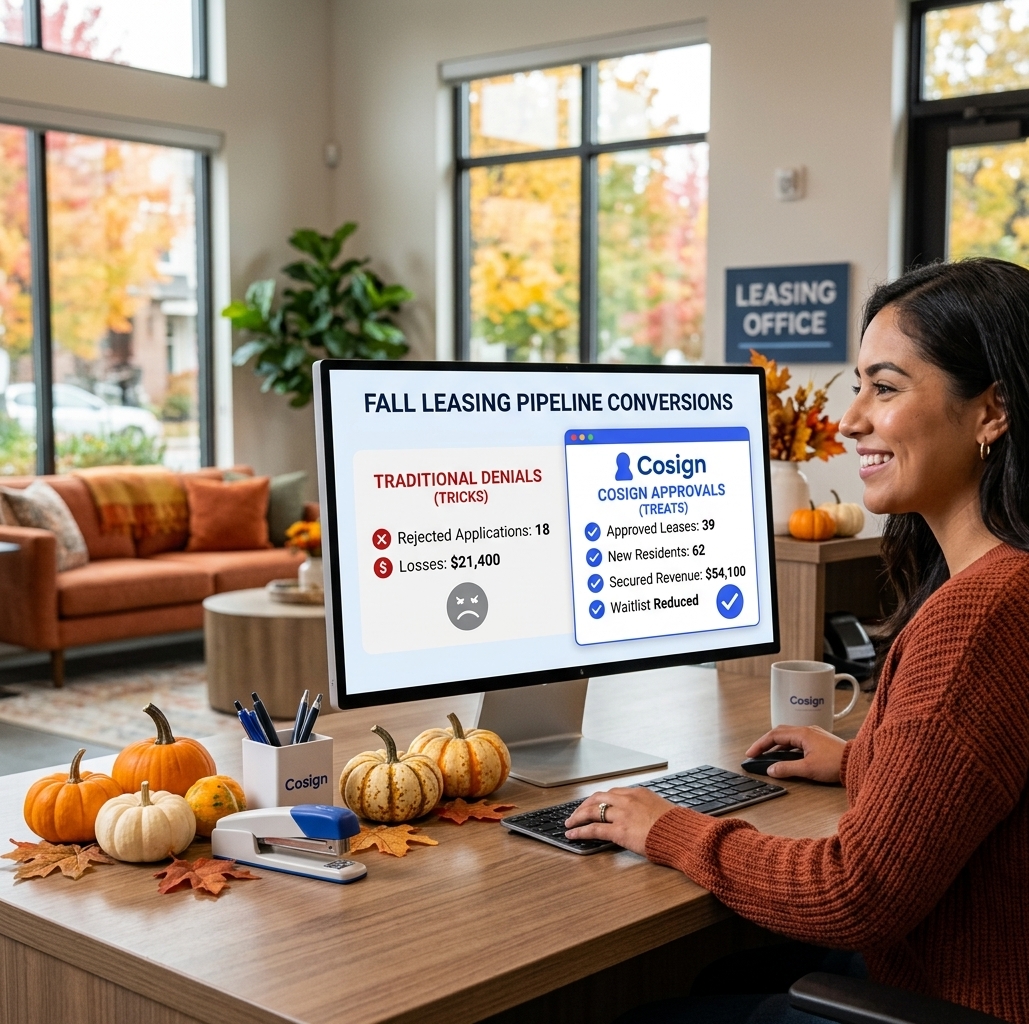
When the drop sits between a decision and a signed lease, some properties offer institutional help such as Cosign so a qualified applicant who falls just outside one written criterion can keep moving toward a lease.







Let’s boost your occupancy rates


