


.svg)


The Buy-vs-Rent Gap Just Hit 105%. What It Means for Multifamily Demand.

TL;DR
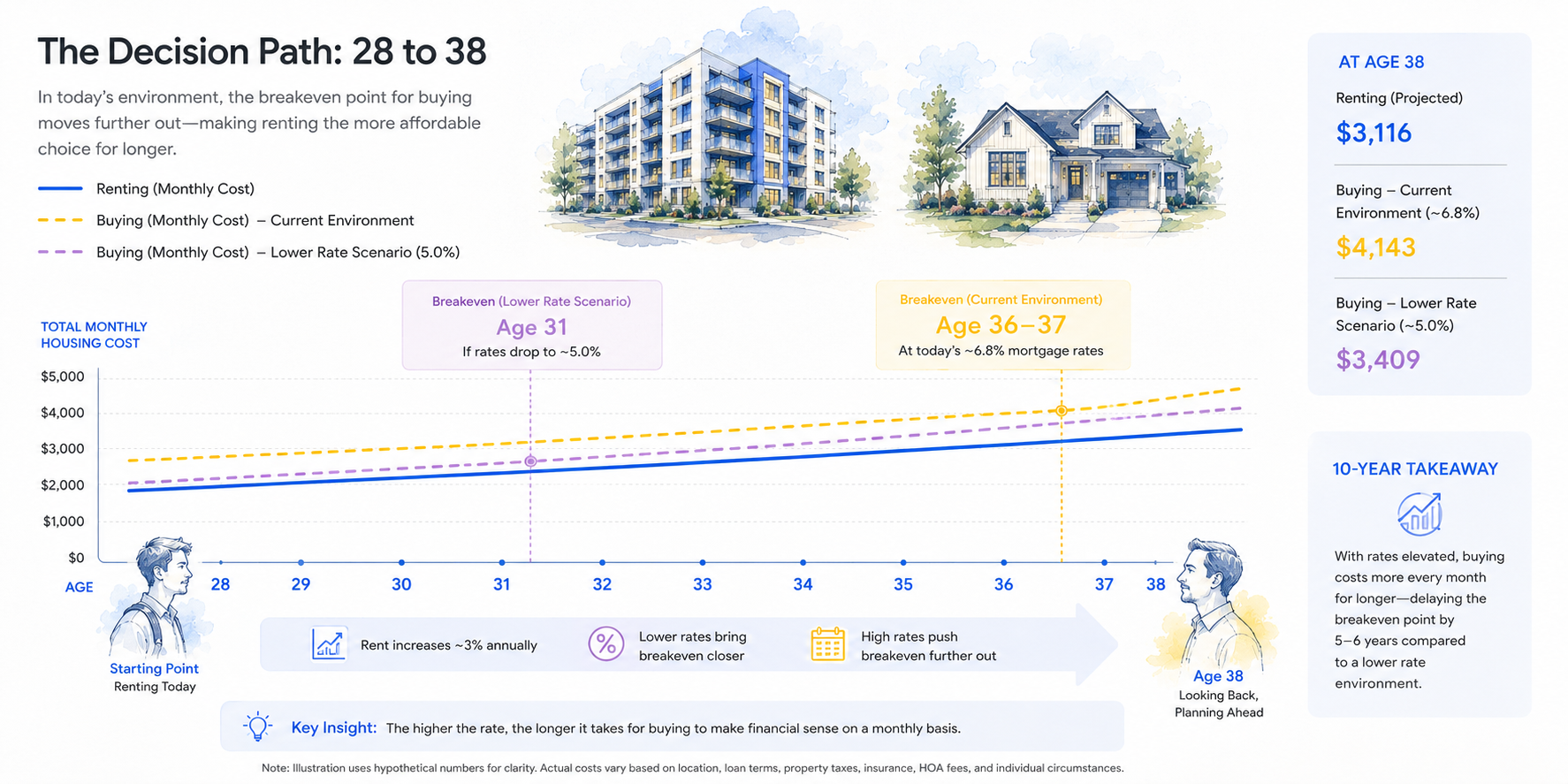
- The monthly cost of owning a median-priced home now runs approximately 105% higher than renting a comparable apartment, according to NAHB analysis of 2026 mortgage rates and home prices. That premium sat in the 20% to 30% range for much of the 2010s.
- Three renter cohorts are being most directly affected: would-be first-time buyers, move-up renters, and relocating professionals. All three are staying in apartments longer than previously planned.
- Long-term renters prioritize different things than transient occupants — in-unit quality, community, renewal predictability, and the management experience. They are also cheaper to retain than to replace.
- Operators who adjust their product, renewal strategy, and marketing positioning to match this shift will outperform those who don't.
- Cosign helps operators capture more of this demand by qualifying non-traditional applicants who are financially stable but don't screen well under legacy frameworks.
The case for renting over buying has rarely been stronger. The monthly cost of owning a median-priced home now runs approximately 105% higher than the monthly cost of renting a comparable apartment, according to NAHB analysis of 2026 mortgage rates and home prices. That premium existed in the 20% to 30% range during much of the 2010s. At 105%, it is in historically unprecedented territory.
For multifamily operators, this is not just a data point. It is a structural demand driver that is extending residencies, deepening the renter pool, and creating a category of long-term renters who are not transitioning to homeownership in any near-term scenario. Understanding that demand dynamic and positioning to capture it is the operational imperative for the back half of 2026 and into 2027.
Why the Gap Got This Wide
Three factors are compounding simultaneously.
The 30-year fixed mortgage rate has remained above 6.5% through the first half of 2026. At that rate, on a median U.S. home price of approximately $420,000 with a 10% down payment, the principal and interest payment alone runs over $2,500 per month before insurance, taxes, and HOA costs.
Despite the rate environment, home prices nationally have not corrected to the degree that would make ownership cost-competitive with renting in most markets. An estimated shortage of 3.4 million single-family homes continues to provide a floor under prices.
At the same time, apartment rents have been flat to slightly down in many markets. That dynamic, while challenging for NOI in some situations, has widened the rent-vs-own premium and made apartments the clear value proposition for most housing consumers. For a deeper look at how occupancy and revenue interact at the property level, see Cosign's guide to net operating income in multifamily real estate.

Who Is Staying in Apartments Longer
The 105% premium is not affecting all renters equally. Three groups are being most directly influenced.
Would-be first-time buyers. Millennials aged 28 to 38 represent the demographic with the highest homeownership aspiration, and this cohort is facing the sharpest cost barrier. Many who planned to purchase in the next one to two years have pushed that timeline out indefinitely. They are staying in apartments, often in urban or suburban submarkets with good access and amenities.
Move-up renters. Residents who previously occupied smaller units and were considering a move to entry-level homeownership are also staying. This group tends to be higher-income, longer-tenured renters who have made peace with renting as a long-term strategy. Operators who adjust their approach to this cohort consistently outperform on renewals — the Ultimate Guide to Resident Retention for Multifamily Operators in 2026 covers what that looks like in practice.
Relocating professionals. Employees relocating for work in markets where home prices are high relative to their income are choosing to rent on arrival and finding the math does not change enough to justify a purchase after several years. This group creates sustained demand in high-employment metros.
What This Means for Operator Strategy
A renter who has concluded that homeownership is not in their near-term plan is a fundamentally different customer than one who expects to buy within 18 months. Long-term renters prioritize in-unit quality, community amenities, renewal predictability, and the management experience. They are more valuable on a lifetime value basis and cheaper to retain than to replace.
Renewal strategy. The long-term renter calculus changes the renewal conversation. Rather than offering modest renewal rates and accepting that some residents will buy, operators can position renewals as the stable, financially rational choice and compete on the total cost and experience comparison rather than just the rent number. For a full breakdown of how leading operators are structuring that experience, see Cosign's piece on renter experience strategies that reduce turnover and boost NOI.
Amenity investment. Residents committing to renting for five or more years have different expectations for unit quality and building amenities than those staying 18 months. Capital allocated to in-unit upgrades and shared amenities generates more value in a long-term renter environment. That investment also shows up directly in asset valuation — the relationship between operational performance and property value is covered in depth in Cosign's guide to net operating income in multifamily real estate.
Marketing positioning. Operators who lead with the rent-vs-own value proposition in their leasing marketing are finding it resonates with the current applicant pool more than messaging focused on unit features alone.
The Demand Tailwind Has a Supply Counterpart
Strong structural demand does not mean operators can ignore supply dynamics. The same conditions that make renting attractive to residents also drive new apartment construction when capital is available. The current supply peak will normalize, but the industry has demonstrated that it responds aggressively to demand signals.
What the 105% premium provides is a floor under demand that makes the current supply cycle less damaging than it might otherwise be. Even in oversupplied markets, vacancy has not spiked as severely as supply volume alone would suggest, precisely because renter demand has remained resilient. Operators who want to understand where occupancy risk actually originates during a supply cycle and what drives it beyond headline vacancy rates, should read Cosign's guide to occupancy risk for multifamily operators.
The combination of supply normalization in the second half of 2026 and sustained structural demand creates the conditions for a meaningful market recovery. Operators who are well-positioned on occupancy, operations, and applicant quality heading into that recovery will be the primary beneficiaries.
How Cosign Fits Into This Demand Environment
Long-term renters who are financially stable but do not screen well under legacy frameworks represent one of the largest untapped segments in the current market. International professionals with limited U.S. credit history, self-employed workers with strong annualized income but irregular deposits, recent graduates, and new hires awaiting their first paycheck are all part of the same structural demand pool that the buy-vs-rent premium is deepening.
Cosign allows operators to approve these applicants without taking on additional default exposure. Renters pay a one-time fee. The property is covered for up to 12x monthly rent, with claims processed within five business days of a documented vacancy. The cost to the operator is nothing.
Asset Living saw a 10% improvement in applicant-to-lease conversion after implementing Cosign, with an average approval time of 24 hours. Read Property Group added $4M in annual revenue through expanded approvals. Freeman Webb's The Dutton achieved 61% conversion at lease-up with a $6.7M increase in estimated asset value within six months.
The structural demand environment is favorable. The operators who capture the most of it will be those who qualify the widest pool of financially stable renters, not just the ones who fit neatly into a traditional screening model.
See how it works for yourself. Book a demo today at rentwithcosign.com.
Frequently Asked Questions
Q: How long is the buy-vs-rent premium likely to persist at current levels?
A: Meaningful reduction in the premium requires either significant mortgage rate declines, which most economists project to be gradual, or home price correction, which is constrained by the housing supply shortage. The premium is likely to persist above historical norms for several years.
Q: Does the premium affect renter demographics in ways that matter for property management?
A: Yes. An older, higher-income, longer-tenured renter cohort has different maintenance demands, amenity preferences, and communication expectations than a younger transient cohort. Operators who adapt their service model to this demographic retain residents more effectively.
Q: Should operators in high-cost markets market directly against homeownership costs?
A: Increasingly, yes. Marketing that makes the rent-vs-own comparison explicit performs well with the current applicant pool, particularly in high-cost metros where the monthly cost differential is most visible.
Q: Does the buy-vs-rent premium affect all apartment classes equally?
A: Demand benefiting from the premium skews toward Class A and well-maintained Class B properties, which are most directly substitutable for entry-level and mid-tier homeownership. Class C properties benefit from different demand drivers, primarily affordability.
Q: How does Cosign help operators capture demand from non-traditional applicants?
A: Cosign functions as a lease guarantor that underwrites the gap between a property's standard qualification criteria and applicants whose financial profiles are strong but non-traditional. The property keeps its screening standards intact. Cosign backs the lease with coverage of up to 12x monthly rent, making it possible to approve international professionals, self-employed renters, recent graduates, and new hires without changing the property's risk exposure.
.avif)
.avif)
.png)
.png)




Aumentemos tus tasas de ocupación


