


.svg)


Multifamily Insurance Pricing Is Stabilizing. Here’s What That Means for Your Budget.
.png)
TL;DR
- After three years of double-digit premium increases, multifamily insurance costs are coming in flat to slightly down at renewal in many inland and well-maintained markets
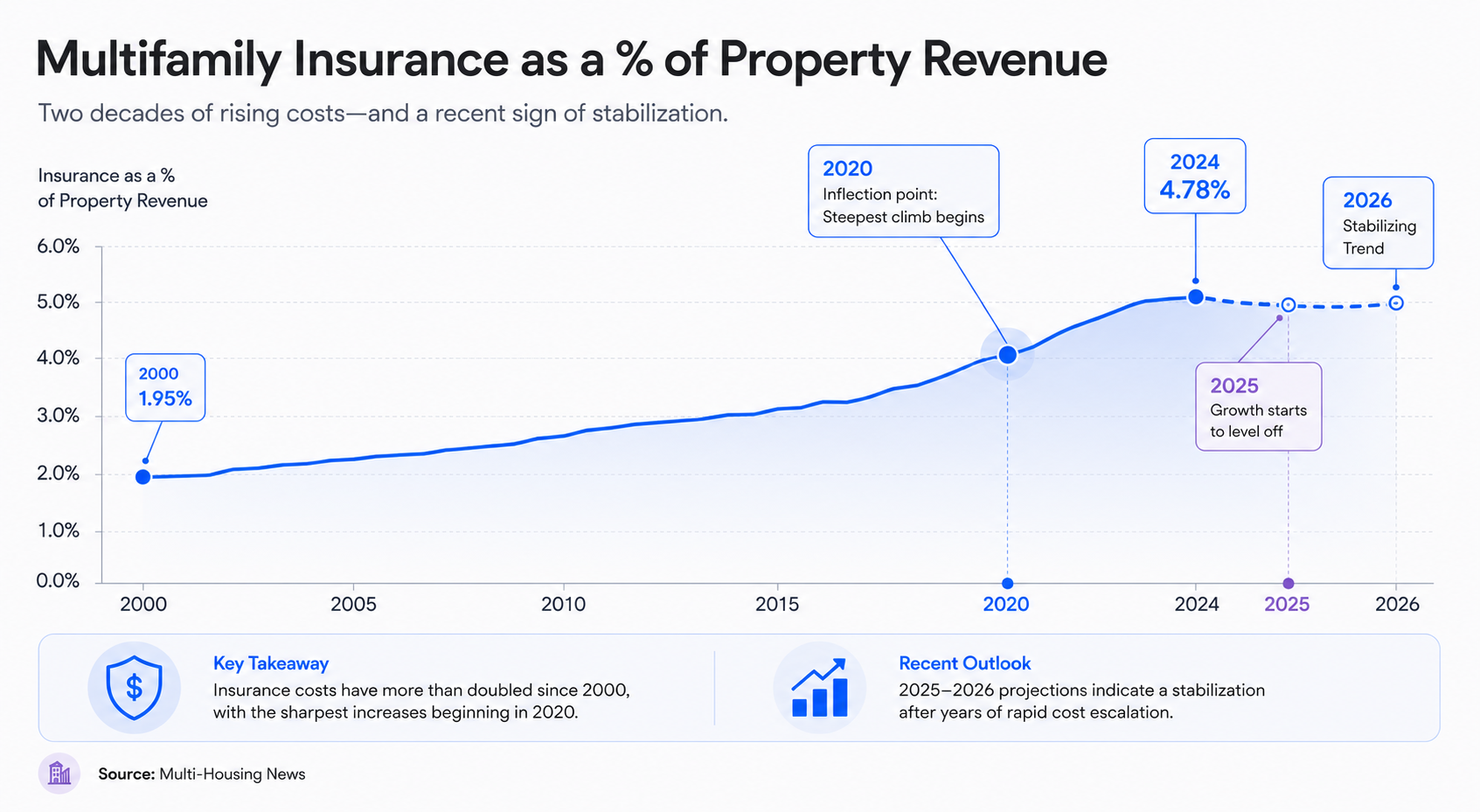
- Insurance climbed from 1.95% of multifamily revenue in 2000 to 4.78% by 2024, making it one of the most damaging NOI line items of the past cycle
- Stabilization is real but uneven: coastal and high-risk weather markets are still paying elevated rates, while Midwest and inland operators are seeing genuine relief
- Operators in favorable markets can potentially recover $50 to $150 per unit annually through disciplined renewal strategy, representing $10,000 to $30,000 in direct NOI improvement on a 200-unit property
- Managing insurance is only one side of the NOI equation. Bad debt multifamily operators absorb from fraudulent or defaulting residents is the other, and a lease guarantor service like Cosign addresses that exposure directly
Why Premiums Spiked and Why They're Easing
The run-up in multifamily insurance premiums from 2021 through 2024 had several causes working simultaneously. Catastrophic weather events drove up reinsurance costs nationwide, including in markets that never directly experienced a major event. Construction cost inflation made replacement cost estimates higher, which increased insured values and premiums proportionally. And elevated claims frequency from water damage and liability incidents drove loss ratios higher for many carriers.
What has changed in 2026 is that reinsurance markets have stabilized as weather-related losses normalized from peak years. Some carriers have returned to markets they exited during the hard cycle, and for properties with strong loss histories, underwriters are now competing more aggressively for business.
Insurance as a percentage of multifamily revenue climbed from 1.95% in 2000 to 4.78% by 2024, according to Multi-Housing News. The NAA's 2026 data shows operators still budgeting roughly $275 to $356 more per unit than pre-spike baselines, but that gap is narrowing in favorable markets. Houston remains an outlier, with rates exceeding $1,200 per unit in some submarkets.
Markets Where Stabilization Is Real
Stabilization is most pronounced in three types of markets.
Low-catastrophe-exposure geographies. Midwestern markets without significant hurricane, wildfire, or flood risk have seen premium pressure ease most noticeably. Operators in metros like Indianapolis, Columbus, Kansas City, and Minneapolis are reporting flat or declining premiums at renewal, giving them a genuine opportunity to right-size insurance as a share of operating expenses.
Well-documented, well-maintained properties. Underwriters are now differentiating between properties based on loss history, maintenance records, and risk controls. A property that can demonstrate proactive roof inspections, plumbing maintenance logs, and low historical claims frequency is positioned to receive more competitive quotes than one presenting minimal documentation.
Properties with strong carrier relationships. Operators who maintained consistent coverage with carriers through the hard market have negotiating leverage at renewal that operators who shopped aggressively every year may not have. Stability in the relationship signals lower administrative risk to underwriters.
How to Capture Better Terms in the Current Market
The stabilization creates a window, but operators have to move strategically to take advantage of it.
Start the renewal process 120 days out. The number of carriers willing to quote multifamily business has increased compared to two years ago. An early start gives your broker time to solicit multiple quotes from carriers who are actively looking to write business in your markets.
Invest in documentation. A comprehensive property condition report, maintenance log, and loss run summary prepared for the underwriter signals a well-run asset. Properties that come to the table organized tend to receive more favorable pricing.
Consider increasing deductibles. In a stabilizing market, raising deductibles in exchange for lower premiums can improve NOI for operators with the reserves to self-insure smaller claims. Run this calculation with your broker against your actual claims history.
Evaluate your coverage structure. Some operators built coverage structures for the hard market, including endorsements and riders that made sense when carriers were restricting terms. With capacity returning, it is worth reviewing whether your current structure still matches your actual risk profile.
.png)
What This Means for NOI Planning
Insurance is now a real line item in operating strategy, not just a cost-of-doing-business expense. With premiums stabilizing and declining in some markets, operators who do the work at renewal can potentially recover $50 to $150 per unit annually. On a 200-unit property, that range represents $10,000 to $30,000 in direct NOI improvement.
That figure belongs on the operating agenda alongside rent growth and expense management. The operators who treat insurance as a negotiable, manageable expense rather than a fixed obligation will consistently outperform those who don't.
But insurance savings are only one side of the NOI equation. The other is the revenue that bad debt multifamily operators absorb from defaulting or fraudulent residents, an exposure that often gets less attention than the insurance renewal process and yet carries comparable financial weight. A single fraud-related eviction in a market like New York City can cost $7,000 to $15,000 in lost rent, legal fees, and unit turn costs. Across a portfolio, that risk compounds in ways that are harder to model than an insurance premium but just as real.
This is where rent protection insurance logic and lease guarantor logic converge. Both are tools for protecting NOI from the unpredictable. The difference is what they protect against: insurance covers physical loss and liability, while a lease guarantor service covers the revenue risk tied to individual leases. A complete NOI protection strategy needs both.
Cosign functions as a lease guarantor service that gives properties a way to approve financially qualified renters who fall short on traditional credit or income metrics, at no cost to the landlord, while capping downside risk through guaranteed coverage if a claim is filed. Claims are paid within 5 business days of approval, with a 60-day filing window after vacancy. For operators who have done the work to tighten insurance costs and want to close the gap on bad debt exposure, this is the remaining variable most directly within their control.
See how it works for yourself. Book a demo today at rentwithcosign.com.
Frequently Asked Questions
Q: If premiums are stabilizing nationally, why is my renewal coming in higher?
A: Geography and property condition drive significant variation from the national average. Coastal markets, flood zones, and properties with claims history are still seeing elevated pricing. The stabilization is most visible for inland, well-maintained assets with strong carrier relationships and documented loss histories.
Q: Is it worth switching carriers for a better rate?
A: Switching has costs beyond the premium. Maintaining a long-term relationship with a carrier can provide advantages in claims handling and future renewal negotiations. Evaluate the full picture, not just year-one pricing.
Q: How does property condition affect insurance pricing?
A: Meaningfully. Underwriters price risk based on the likelihood and severity of future claims. A property with documented preventive maintenance, updated systems, and a low historical loss ratio presents a fundamentally different risk profile than one without that documentation, and the premium reflects that difference.
Q: Should insurance savings go back to NOI or be reinvested in capital improvements?
A: Ideally both, in proportion. Some operators use insurance savings to fund the preventive maintenance that keeps future premiums low, which creates a compounding effect over time.
Q: How does a lease guarantor service relate to rent protection insurance?
A: They protect against different risks but serve the same ultimate goal: protecting NOI from unpredictable losses. Rent protection insurance and related coverage tools address physical loss and liability. A lease guarantor service like Cosign addresses revenue risk at the lease level, covering unpaid rent and qualifying damages when a resident defaults. A complete risk management strategy considers both.
Q: What does additional rent mitigated risk mean in a lease context?
A: Additional rent mitigated risk refers to structures where a third party, typically an institutional guarantor company, backstops the rent obligation on a specific lease. The "additional rent" framing reflects that the guarantor's obligation runs alongside the primary lease obligation rather than replacing it. Cosign operates on this structure, guaranteeing up to 12x monthly rent per covered lease.
.avif)
.avif)




Let’s boost your occupancy rates


