


.svg)


Fraud Red Flags vs. Non-Traditional Renters: How Operators Tell the Difference
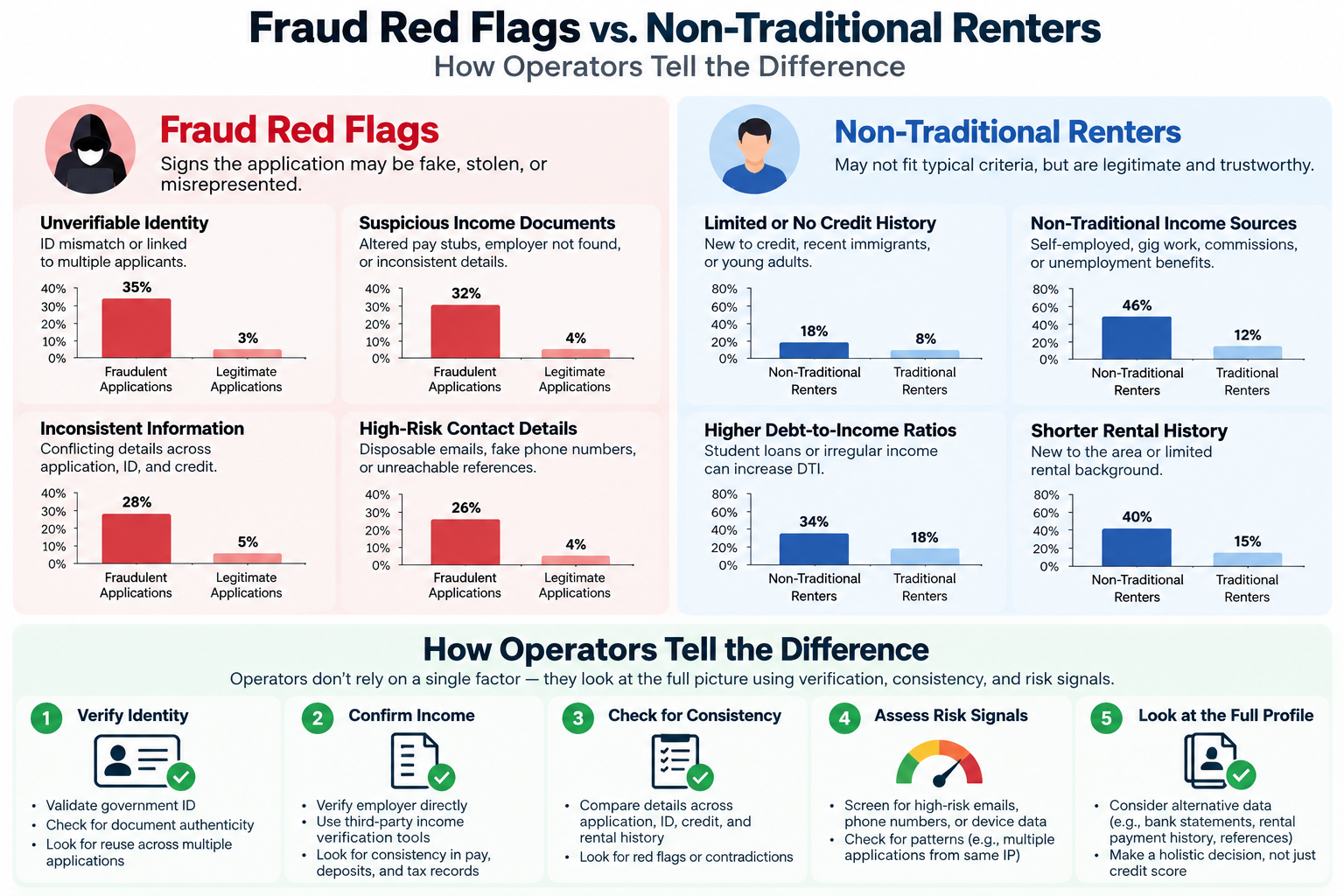
Tighten screening to catch more fraud, and you will catch more of something else too: qualified renters whose paperwork just does not look like everyone else's. The signals that flag a fraudulent application and the signals that flag a freelancer, an international student, or a traveling healthcare worker often look identical on paper. Telling them apart is where a lot of screening processes quietly break down.
Why the Two Get Confused
Application fraud detection leans heavily on pattern-matching: income that does not match documentation, inconsistent employment history, identity information that does not fully verify. Those are the right things to watch for. The problem is that a legitimate non-traditional renter can trip several of those same wires without any fraudulent intent at all. A freelancer's income genuinely is inconsistent month to month, and an international student's identity information genuinely will not fully verify against U.S. databases.
What Real Fraud Risk Looks Like
Fraud red flags tend to involve fabrication, not absence: falsified pay stubs, a synthetic identity, an employer that does not exist when verified, or documentation that contradicts itself under scrutiny. These are cases where something was manufactured to pass screening.
What a Non-Traditional Profile Looks Like
A non-traditional renter's file usually does not contradict itself. It is just incomplete relative to a traditional model. No W-2, but real bank statements. No U.S. credit history, but a funding letter from a university. A 13-week contract instead of a permanent role, but verifiable income for the lease term. The information that is present is honest. There is just less of a standard paper trail behind it.
The Cost of Getting This Wrong
Treat every incomplete file like a fraud risk, and denial rates climb on renters who were never a threat to the lease. Treat every red flag as harmless, and real fraud slips through. Neither mistake is cheap. One costs occupancy. The other costs NOI directly through default and delinquency.
Where an Institutional Guarantee Fits
Cosign does not change how fraud gets screened. That layer of the process stays exactly as rigorous. What it changes is what happens to the applicant who is flagged for incompleteness rather than fabrication. Instead of a denial, that applicant gets a pivot instead of a rejection, backed by Cosign's rent guarantee, while true fraud risk continues to be denied outright.
The Result
Operators get a screening process that still catches fraud with full rigor, while nearly-perfect applicants (the ones penalized for being non-traditional rather than risky) convert into signed, protected leases instead of denials.
Approve with confidence. Protect NOI. Expand approvals.
Book a Demo to see how Cosign separates fraud risk from non-traditional applicants in your pipeline.
.avif)
.avif)
.jpeg)

.png)



Let’s boost your occupancy rates


