


Approving Self-Employed and Gig-Worker Applicants with Confidence

A record 74.9 million Americans now earn income independently, according to MBO Partners' 2026 State of Independence report. They are designers, rideshare drivers, consultants, nurses on contract, and small business owners. Many of them earn well and pay their bills on time.
Yet a lot of leasing workflows were built around a single document: the W-2 pay stub. When an applicant can't produce one, the file stalls, gets flagged, or quietly ends in a denial. That is a missed lease, not a risk avoided.
The good news is that self-employed income is very verifiable. It just needs a slightly different playbook.
Why self-employed applicants are worth the extra step
- They're a large and growing pool. Independent work is now a mainstream career path, not a side note.
- They often stay put. Many freelancers and business owners work from home and value a stable, comfortable space.
- Your competitors may be saying no. An operator who can approve these applicants with confidence wins leases others leave on the table.
What to ask for instead of pay stubs
The goal is to confirm two things: how much the applicant earns, and how steady it is. A combination of these documents usually tells the story clearly.
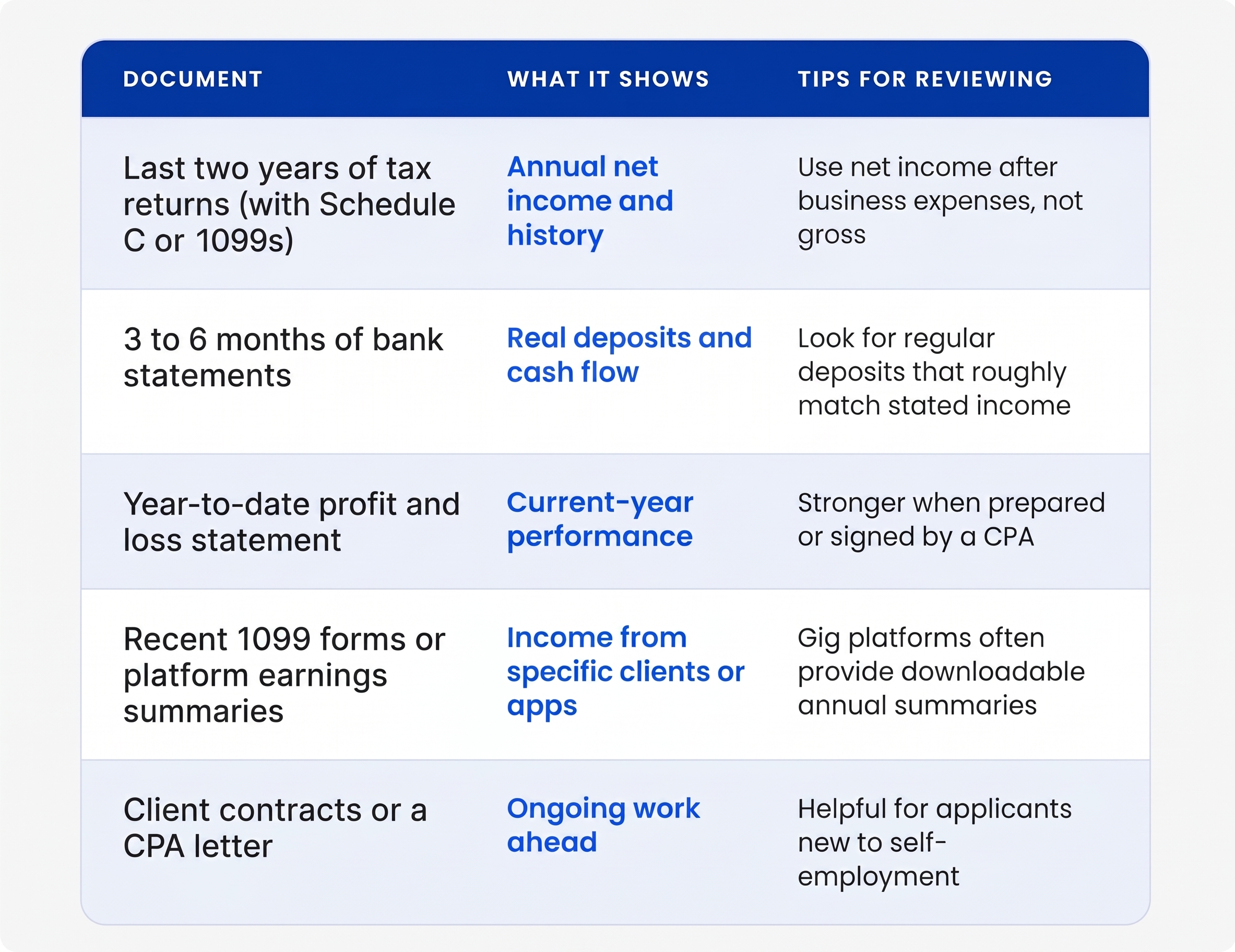
You don't need every item. Pick a standard set, write it into your criteria, and apply it to every self-employed applicant the same way.
Focus on consistency, not just the number
Self-employed income often moves month to month. A designer may land a large project in March and a smaller one in April. That's normal.
A helpful approach is to average deposits over 6 to 12 months instead of judging a single month. Look at the trend line. Is income steady, growing, or sharply declining? A steady or growing trend is a strong signal, even with some monthly swings.
Keep verification secure
Income documents are a common target for fraud, and AI tools have made fakes easier to produce. A few simple habits keep you protected without slowing good applicants down:
- Verify bank data at the source when possible, using bank-connection or income-verification tools rather than uploaded PDFs alone.
- Cross-check the documents against each other. Tax return income, bank deposits, and P&L figures should tell the same story.
- Confirm third parties. A CPA letter should come from a CPA you can look up.
For more on spotting altered documents, see our blog on AI-forged documents.
Give your team a clear path
Leasing teams move faster when the process is written down. Add a short "self-employed applicant" section to your screening criteria that lists:
- The accepted documents
- How income is calculated (for example, the average of the last 12 months of net deposits)
- Who reviews files that fall just outside the guidelines
This keeps decisions consistent and helps you apply the same standards to every applicant.
When the file is close, add support instead of saying no
Some self-employed applicants will be strong on payment history but just short on documented income, often because they're new to freelancing or had a slower year. These are exactly the applicants lease coverage is built for.
With Cosign, operators can approve qualified applicants who fall just outside traditional criteria while keeping the rent protected. Your team gets to say yes, and your rent roll stays secure.








Let’s boost your occupancy rates


