


.svg)


Occupancy Risk for Multifamily Operators: Causes, Costs, and How to Fix It

Occupancy risk for multifamily operators is one of the most misunderstood threats to portfolio health. A building can look full on paper while quietly bleeding revenue, and by the time the numbers catch up, the damage is already done.
Most operators are familiar with vacancy. Fewer think carefully about the broader category it belongs to: occupancy risk.
The distinction matters because vacancy is just one way a rent roll can underperform. Delinquency, concessions, fraud, and resident defaults all reduce the income a property actually collects, even when every unit has a name on the lease.
This article covers what occupancy risk is, how operators create it unintentionally under leasing pressure, what it costs, and the upstream strategies that address it before it reaches the income statement.
What Is Occupancy Risk for Multifamily Operators?
Occupancy risk is the probability that a multifamily property will fail to collect its full potential rental income.
It encompasses vacancies, resident delinquencies, concessions, fraud, and defaults: any force that creates a gap between gross potential rent and actual collected revenue.
Occupancy risk is not the same as vacancy. Vacancy is a symptom. Occupancy risk is the condition that produces it, and several others.
Filling units and protecting your rent roll don't have to be competing goals. See how Cosign works.
Physical Occupancy vs. Economic Occupancy
Physical occupancy measures the percentage of units currently occupied by residents. It is the number most operators report, and most investors hear about first.
Economic occupancy measures something more meaningful: the percentage of gross potential income actually collected, after accounting for unpaid rent, delinquencies, concessions, and vacancy loss. A property can sit at 95% physical occupancy and collect only 85% of its potential income once bad debt and concession burn-off are factored in.
Industry benchmarks reflect this nuance. A natural vacancy rate of 4 to 6% is widely considered the optimal balance between revenue maximization and risk tolerance. Pushing physical occupancy above that threshold, especially through concessions or loosened screening, often creates more economic risk than it resolves.
Why Economic Occupancy Is the Metric That Actually Matters
Physical occupancy is a lagging indicator. It tells operators what has already happened. Economic occupancy is the forward-looking signal tied directly to net operating income, debt service coverage, and asset valuation.
Operators and lenders increasingly treat economic occupancy as the true health check on a property. A building that reports 96% physical occupancy but carries significant bad debt and heavy concession exposure is a fundamentally different asset than its headline number suggests.
How Multifamily Operators Unintentionally Create Occupancy Risk
Most occupancy risk is not the result of bad luck or market forces alone. It is the product of decisions made under pressure to fill units: decisions that solve a short-term leasing problem while creating a longer-term revenue problem.
Weakened Applicant Screening
Lowering credit thresholds and income verification standards in response to supply pressure is one of the most direct ways operators introduce occupancy risk into a portfolio. Applicants accepted today under relaxed criteria are tomorrow's delinquency exposure.
It helps to think about the landlord-tenant relationship clearly: landlords are unsecured creditors. If a resident stops paying rent, there is no asset to repossess. The unit cannot be reclaimed quickly. The loss is absorbed by the property. That dynamic makes screening discipline a financial safeguard, not an administrative formality.
The question to ask about every application is not just "can they pay?" but "do they pay?" Income verification tells you the first. Credit behavior tells you the second. Both are necessary.
Rent Concessions That Undermine Renewal Stability
Offering two or three months of free rent to hit a lease-up target is a common tactic in oversupplied markets. The occupancy number improves, but this doesn't guarantee the revenue picture will follow suit.
The structural problem surfaces at renewal. Residents who qualified based on the concession-adjusted effective rent often could fail to sustain the full contract rent once the free period ends. Defaults, nonrenewals, and turnover costs follow, eroding the revenue the concession was meant to protect.
Heavy concession use also distorts lease comps, which creates downstream complications for appraisals and refinancing.
Security Deposit Compression
The industry-wide shift toward low or no security deposits, particularly in competitive lease-up environments, reduced friction at move-in. It also removed a financial buffer that historically offset bad debt when placements went wrong.
Lower deposit requirements are not inherently problematic. Combined with loosened screening and aggressive concessions, though, they concentrate risk at the portfolio level rather than distributing it.
Supply Pressure and the Race to Stabilize
The influx of new multifamily supply has pushed vacancy rates sharply higher in many markets, particularly across parts of the Sun Belt where new deliveries have exceeded absorption. Operators under pressure to stabilize new assets are making qualification decisions they would not otherwise make.
The result is a market where average applicant credit quality has declined in some submarkets: not because the renter pool has changed, but because operators are reaching further down it.
Renter Fraud
Renter fraud has grown in markets where screening standards have loosened. Fraudulent applications inflate apparent occupancy while placing residents with no ability or intention to pay on the rent roll.
Fraud detection requires more than credit checks. Income document verification, identity confirmation, and cross-referencing applicant data are now standard risk-management practices in well-run operations.
This is especially true given the recent rise in synthetic identity fraud.
The Real Cost of Occupancy Risk to Multifamily Operators

Bad Debt Expense and NOI Erosion
Bad debt is not just a line item. It is a direct reduction to net operating income and, through cap rate compression, to asset value. Bad debt expenses have grown as operators traded screening rigor for occupancy speed: a trade that rarely pencils out when the full cost is modeled.
A property carrying 5% bad debt as a percentage of gross potential rent is not a 95%-performing property. It is a property with an income problem that will eventually surface in the financials.
Turnover Costs and Unit Downtime
A failed tenancy compounds quickly. Lost rent during vacancy, make-ready expenses, leasing fees, and the time cost of re-leasing add up to a figure that almost always exceeds what a month of vacancy would have cost.
The strategic implication is clear: waiting for the right resident is rarely the more expensive path, even when it feels that way under leasing pressure.
Loan Delinquency Risk
When economic occupancy falls short of projections, operators can struggle to meet debt service obligations even when physical occupancy appears healthy. Weaker income streams at the property level, driven by bad debt, concessions, and resident defaults, are a leading cause of loan performance issues across the multifamily sector.
Lenders are paying closer attention to economic occupancy metrics during underwriting and covenant reviews. Operators who cannot demonstrate healthy collected income, not just high physical occupancy, face refinancing headwinds.
Proven Strategies to Reduce Occupancy Risk for Multifamily Operators
Hold Screening Standards and Expand the Qualified Applicant Pool Instead
The answer to supply pressure is not to lower qualification standards. It is to widen the pool of applicants who can meet them.
Rent guaranty products allow operators to approve applicants who narrowly miss traditional qualification thresholds without increasing exposure to delinquency risk. The guaranty covers the operator's downside if a resident defaults, which means the screening logic can include a broader set of applicants without weakening the portfolio's financial position.
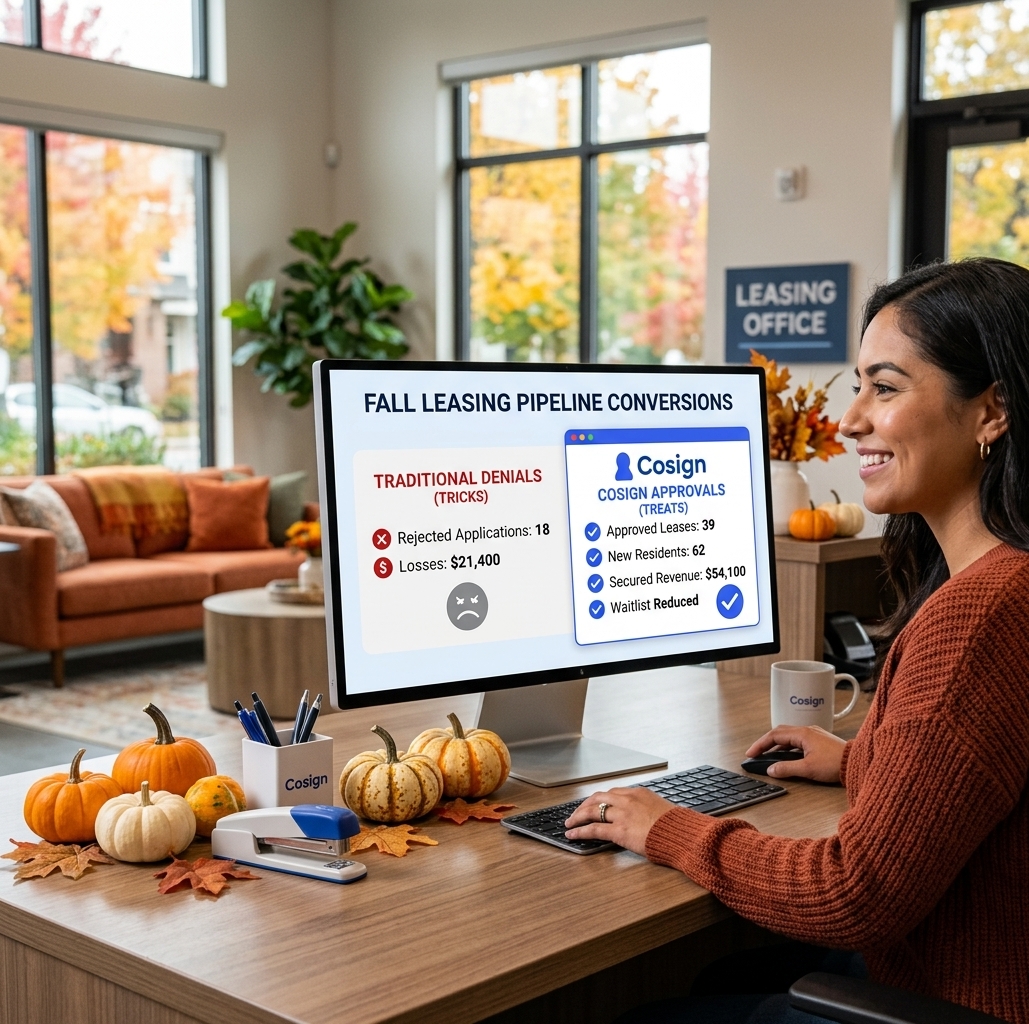
Cosign works with multifamily operators as a rent guarantor for qualified applicants who fall just short of standard income or credit thresholds. Operators fill units without compromising underwriting discipline, and residents who are genuinely creditworthy but fall slightly below a cutoff get a path to approval.
Use Predictive Occupancy Forecasting
Spreadsheets and static reports tell operators what already happened. Reducing occupancy risk requires visibility into what is about to happen: which leases are expiring in the next 30 to 120 days, what leasing velocity looks like against those expirations, and where demand signals are trending.
AI-driven forecasting tools give teams time to act on upcoming exposure before it becomes a vacancy. Pricing adjustments, proactive renewal outreach, and targeted marketing campaigns are all more effective when launched ahead of the problem, not in response to it.
Track Economic Occupancy, Not Just Physical Occupancy
The operational shift from "units filled" to "income collected" starts with what operators measure. A KPI dashboard built around physical occupancy alone obscures the financial health of the property.
Metrics that matter: bad debt as a percentage of gross potential rent, average days delinquent, percentage of the rent roll on payment plans, and concession value as a percentage of effective rent. These numbers tell a different story than the occupancy rate, and often a more accurate one.
Transfer Risk Through Guarantor Products and Lease Insurance
Where individual applicant risk cannot be fully eliminated through screening, it can be transferred. Two primary instruments exist for this purpose.
- Surety bonds underwrite the individual applicant, providing a guarantee on that resident's specific obligations.
- Lease insurance underwrites the property's risk across the rent roll, spreading exposure rather than isolating it.
Both instruments reduce bad debt exposure without requiring operators to raise security deposits or push screening thresholds to the point of pricing out qualified renters.
Invest in Resident Retention to Protect Economic Occupancy
Turnover is one of the most expensive and underappreciated drivers of occupancy risk. Every departure opens a vacancy period, triggers make-ready costs, and reintroduces placement risk. Every renewal avoids all three.
Operators should track renewal rate and turnover cost per unit as primary performance metrics, not secondary observations. A portfolio that retains proven-paying residents compounds its economic occupancy position over time. One that churns through residents repeatedly absorbs those costs repeatedly.
FAQ
What is the difference between physical occupancy and economic occupancy?
Physical occupancy measures the percentage of units currently occupied. Economic occupancy measures the percentage of gross potential income actually collected after deducting unpaid rent, delinquencies, concessions, and vacancy loss. A property can show strong physical occupancy while economic occupancy, the figure tied to actual cash flow, lags significantly behind.
What causes occupancy risk in multifamily properties?
The most common causes are weakened applicant screening under leasing pressure, rent concessions that erode renewal stability, security deposit compression, new supply pushing operators toward qualification decisions they would otherwise avoid, and renter fraud. Most occupancy risk is introduced at the front end of the leasing process, not during tenancy.
Conclusion

Occupancy rate is a useful number. On its own, it is not a complete picture. Economic occupancy, the income a property actually collects, is what determines cash flow, debt coverage, and long-term asset value.
Operators who protect their rent rolls upstream, at qualification, screening, and renewal, face fewer downstream problems: less bad debt, fewer evictions, lower turnover costs, and healthier coverage ratios. The tools to do this exist. The question is whether the operational culture prioritizes long-term revenue over short-term occupancy numbers.
For operators looking to expand their qualified applicant pool without lowering standards, Cosign provides rent guarantor coverage that bridges the gap between a strong applicant and a clean approval. Filling units and protecting the rent roll are not competing goals.
.avif)
.avif)






Aumentemos tus tasas de ocupación


