


.svg)


Guarantor vs Cosigner: The Operator's Guide

Multifamily occupancy rates have averaged 95% across the country in 2025. A huge reason for this is that fewer young adults can afford to buy homes, and so are leasing properties longer.
It also means that multifamily teams are now also encountering more applicants with thin credit files, irregular income, or limited rental history. These applicants aren't necessarily risky tenants. They simply fall just short of rigid screening thresholds.
The real challenge this creates is finding a reliable way to convert these "almost qualified" renters without exposing the property to additional risk or adding friction to the leasing process.
Co-signers and guarantors have traditionally played this role, offering an extra layer of financial security when applicants don't meet standard criteria. But while both solutions help, they function very differently in practice.
In this article, we're breaking down the differences through an operator lens, highlighting where each option fits, where each falls short, and what a scalable alternative looks like for modern multifamily teams.
Meaning of Co-Signer vs Guarantor
At a high level, both co-signers and guarantors provide an added layer of financial assurance when a renter doesn't fully meet your screening criteria. The key difference is how and when each party becomes responsible.
Co-Signer
A co-signer is added directly to the lease as a full leaseholder with joint and several liability from day one. They are equally responsible for all lease obligations throughout its entire term.
Guarantor
A guarantor signs a separate guaranty agreement and is not a leaseholder. Their liability activates only if the primary tenant fails to meet obligations.
What are the Key Differences in a Guarantor vs Co-signer Arrangement
.avif)
How to Choose Between a Co-signer and a Guarantor
Owners and landlords aren't obligated to use either option. However, they offer an added layer of risk mitigation when dealing with less-than-perfect tenants. Here are a few core things operators should look at when deciding which option to use:
1. Risk Security
Which structure provides the clearest and most enforceable path to repayment if the renter defaults? Co-signers offer immediate recourse under the lease, while guarantors require enforcing a separate guaranty.
2. Underwriting Requirements
Both options require financially stable supporters, but co-signers typically undergo more thorough screening because they are added to the lease. Guarantors are screened for their ability to step in only if needed.
3. Portfolio Scalability
Large operators need solutions that work across thousands of units. Both co-signers and personal guarantors depend on a renter's personal relationships, limiting consistency and scale.
4. Operational Load
Co-signers add ongoing lease-management complexity, while guarantors create procedural steps only when a lease becomes delinquent.
5. Regulatory Considerations
Operators must navigate state-by-state differences in how guaranties and co-signed leases are enforced, which shapes collections workflows, documentation processes, and legal timelines.
Ultimately, the decision comes down to choosing the mechanism that best aligns with portfolio consistency, operational efficiency, and risk tolerance.
Workflow Implications for Operators
Beyond the strategic considerations above, each option creates distinct operational realities that compound across a portfolio.
With co-signers, every lease becomes a multi-party agreement. This means doubling communication touchpoints during lease signing, renewal negotiations, and any mid-lease modifications. When a co-signed lease needs updating, you're coordinating schedules and signatures across multiple parties—often in different cities or states. Multiply this across hundreds of units, and lease administration overhead grows exponentially.
Guarantors reduce day-to-day friction but shift complexity to enforcement. When a tenant defaults, operators must locate the guarantor, serve proper notice under the guaranty terms, and pursue collections through a separate legal instrument. This creates inconsistent timelines across delinquent accounts since guarantor responsiveness varies widely. Collections teams lose the predictability of standard lease enforcement, making it harder to forecast recovery rates or staff workloads appropriately.
The deeper issue is neither approach standardizes across a portfolio. Co-signers require individually vetted supporters with varying financial profiles. Guarantors depend on each tenant's personal network, introducing variability in both availability and quality. Regional leasing managers can't rely on consistent approval pathways, and portfolio-level reporting becomes difficult when each marginal approval follows a different structure.
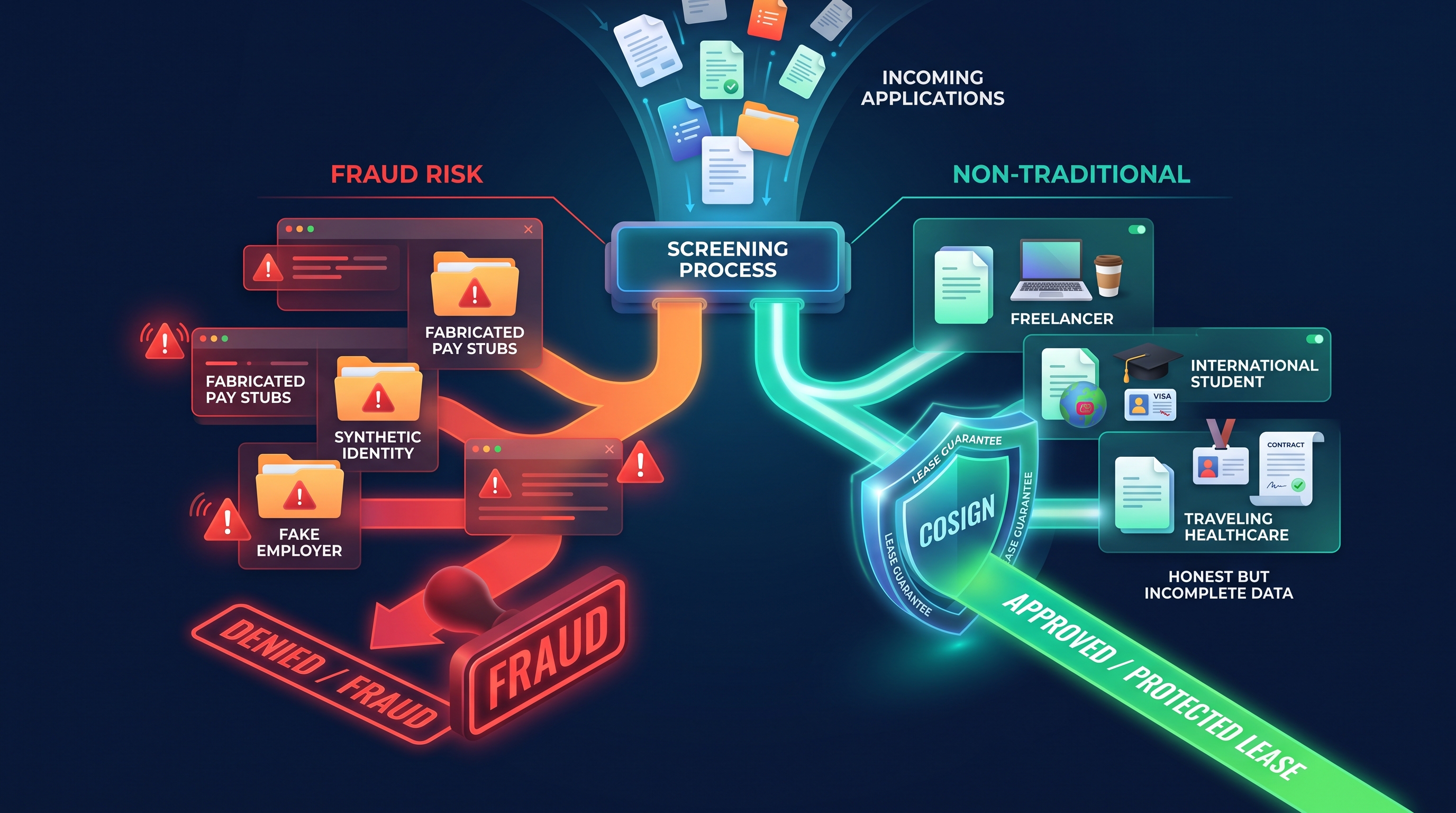
Third-party guarantors solve these core limitations. Instead of relying on an applicant's personal network, a third-party platform underwrites the renter directly, assumes financial responsibility, and provides operators with a standardised, portfolio-ready solution.
This structure removes the friction of adding new leaseholders, eliminates the variability of personal guarantors, and gives operators a consistent, enforceable mechanism for approving more applicants without increasing risk.
For multifamily teams looking to strengthen approvals, protect NOI, and streamline operations, a third-party guarantor is the modern alternative. To learn how Cosign can support your portfolio, book a call with our team.
.avif)
.avif)


.jpeg)
.jpeg)


Aumentemos tus tasas de ocupación


