


.svg)


The ultimate guide to AI leasing tools for operators in 2026

AI leasing tools for operators are no longer a competitive edge. In the US multifamily market, they have become the baseline for keeping up with renter expectations and protecting net operating income.
Research shows that renters expect a response within 24 hours of reaching out about a listing, and properties that respond within five minutes are dramatically more likely to qualify a lead.
For most leasing teams, hitting that bar manually is not realistic. Inquiry volume does not follow a 9-to-5 schedule, staffing costs are rising, and the generalist model that once held portfolios together is showing its limits.
AI steps in not to replace leasing staff, but to handle the volume they cannot, so that human agents can focus on the relationships and closings that actually require them.
This guide covers the best AI leasing tools operators can use right now: what they do, who they are best for, how to evaluate them, and how to measure what they are actually worth to your portfolio.
Why property operators need AI leasing tools today
The US multifamily market is moving faster than traditional teams can handle
Flat rent growth, persistent NOI pressure, and rising labor costs have converged at the same time. The result is an operating environment where efficiency is no longer optional. Properties that rely on property-siloed, generalist staffing models are experiencing the consequences: lead decay from slow response times, high tour no-show rates, and communication breakdowns between residents and overextended teams.
The gap between tech-forward operators and traditional ones has grown into something more consequential than a technology preference. It is a direct NOI gap. Operators running AI-assisted workflows are handling more inquiries, filling vacancies faster, and retaining residents longer without adding headcount.
AI is a teammate, not a replacement
The most persistent concern about AI in leasing operations is that it eliminates jobs. The reality is that well-designed AI tools do the opposite: they free leasing agents from high-volume administrative work so they can spend more time on the tasks that require human judgment.
Qualifying a complex applicant, navigating a difficult renewal conversation, building rapport with a prospective resident: those are human jobs. Responding to a midnight inquiry about pet policy is not.
The operators seeing the best results are not replacing their teams with AI. They are building leaner, more specialized teams and giving them AI to handle the volume.
Meeting renter expectations with 24/7 response times
Renters search for apartments at night and on weekends. If your team is not available, the lead goes to whoever is. AI solves the availability problem without the cost of a call center. A qualified prospect who submits an inquiry at 11 PM can receive an immediate, accurate response, get pre-screened, and have a tour booked before your leasing office opens the next morning.
After-hours coverage is one of the clearest and fastest ROI calculations in this category. Operators who replace or reduce call center contracts with AI typically see payback within the first few months.
Centralizing leasing operations for portfolio scale
The traditional model assigns one generalist leasing agent to each property. As portfolios grow, that model multiplies costs and inconsistencies. AI enables a different architecture: a centralized team of specialists managing leads, communications, and scheduling across an entire portfolio from a single hub, with AI handling the routine layer at each property.
For enterprise operators, centralization is the lever that makes scale sustainable. For owner-operators managing a handful of properties, it means getting the output of a larger team without hiring one.
Essential workflows powered by AI leasing tools for operators
Intelligent prospect screening and lead qualification
AI tools can collect the information your team needs before a human agent ever gets involved: move-in date, budget, pet situation, income range, and unit preferences. That data gets captured 24/7 from any channel, logged into your property management system, and used to rank leads by likelihood to convert.
Leasing agents who previously spent hours on intake calls can instead focus their time on the prospects most likely to sign. The lower-quality inquiries get qualified out or nurtured automatically.
Automated tour scheduling and rescheduling
AI tools with PMS calendar integration can offer available tour slots, confirm bookings, and send reminder sequences without any human involvement. No-show rates drop when prospects receive automated reminders in the 24 and 2-hour windows before their scheduled time.
The same tools handle rescheduling. When a prospect needs to change their time, the AI manages the exchange and updates the calendar automatically. This is one of the most straightforward time-savings in the leasing workflow and one of the first places operators see measurable results.
What is agentic AI, and how does it differ from a basic chatbot?
A basic chatbot follows a script. It can answer a predefined set of questions, but it cannot take action, understand nuance, or adapt when the conversation goes off-script.
An agentic AI understands what a prospect or resident actually intends, executes multi-step workflows in response, and writes data directly back into the property management system without requiring a human handoff.
In practice, that means an agentic AI can triage a maintenance request, classify it as an emergency, create a work order in AppFolio, and dispatch a vendor from your pre-approved list at 2 AM, all without waking anyone up. A basic chatbot cannot do that.
When evaluating platforms, operators should ask vendors directly which category their product falls into. The distinction has significant operational consequences.
Maintenance coordination and after-hours triage
Maintenance is often the highest-friction workflow in a leasing operation and the one most likely to drive resident turnover when it goes poorly. AI tools built for maintenance handle the full intake process: taking the call, asking the right clarifying questions, understanding urgency, creating a work order, and dispatching the appropriate vendor.
For owner-operators who currently handle emergency maintenance calls personally, this is often the single highest-value workflow to automate first. The time reclaimed is immediate, and the resident experience improves because emergencies get addressed faster through an organized dispatch process rather than through a groggy phone call at midnight.
Top AI leasing tools for multifamily operators in 2026
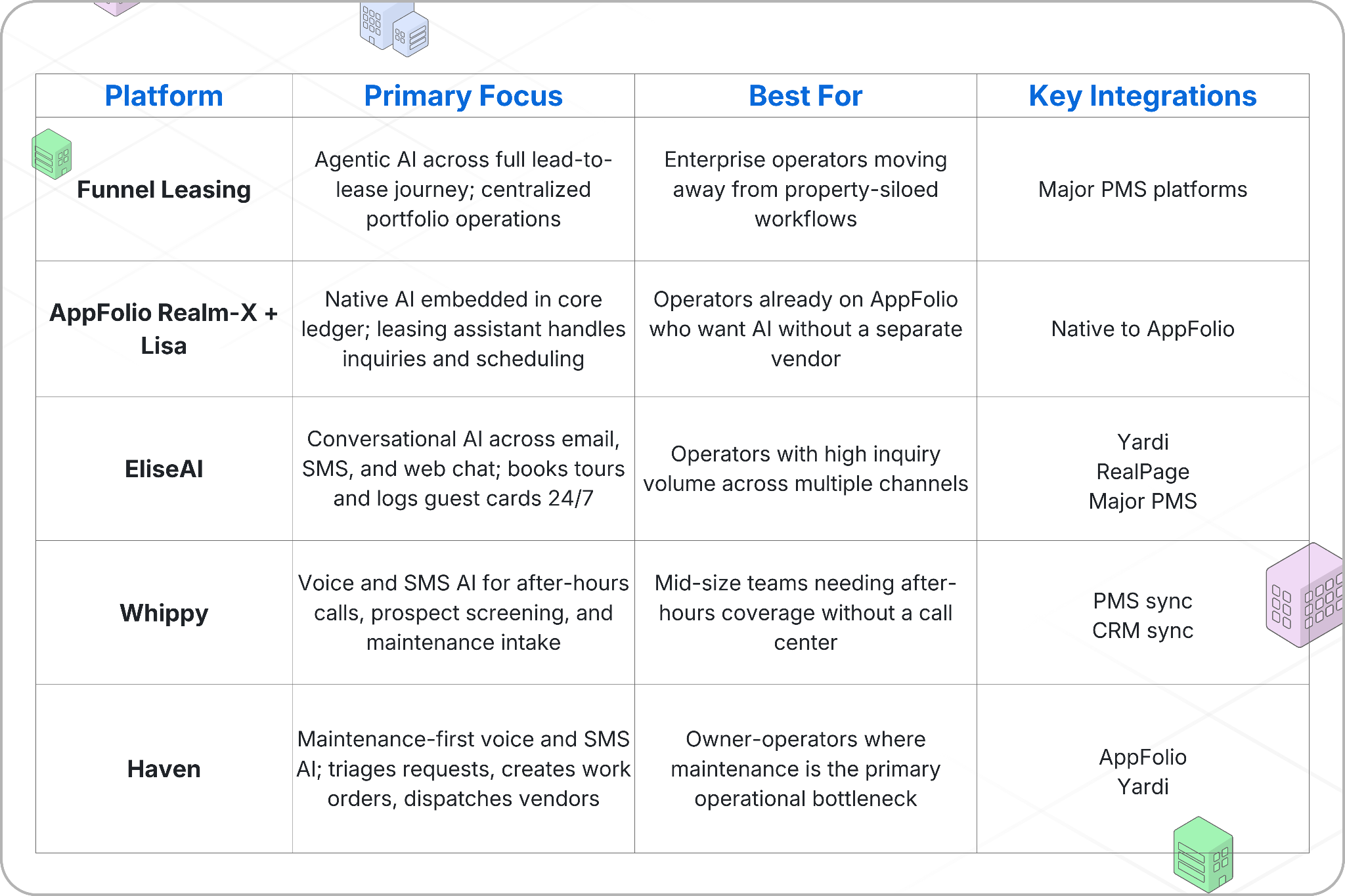
Funnel Leasing: agentic AI for centralized enterprise operations
Funnel is built around the idea that enterprise operators should not have to choose between efficiency and renter experience. Its renter-centric CRM uses agentic AI to manage the entire lead-to-lease journey, and its architecture is designed specifically for centralized operations. A specialized team can manage leads and communications across a full portfolio from a single hub, with AI handling volume at the property level.
Funnel reports a 70% faster approval-to-lease timeline and 96% positive renter ratings on application workflows for its customers.
Best for: enterprise operators moving away from property-siloed workflows Key integrations: major PMS platforms, bi-directional
AppFolio Realm-X and Lisa: integrated AI built into the core ledger
AppFolio embeds AI directly into its platform rather than treating it as a separate add-on. Realm-X is its AI layer; Lisa is the AI leasing assistant that handles prospect inquiries and tour scheduling natively. For operators already running AppFolio, this means adding AI capability without adding a separate vendor, a separate integration, or a separate contract.
AppFolio reports that its AI leasing tools save property managers over 10 hours per week on average.
Best for: operators already on AppFolio who want AI without a separate vendor Key integrations: native to AppFolio
EliseAI: conversational AI for high-volume leasing teams
EliseAI handles high-volume, human-like conversations across email, SMS, and web chat. It books tours, logs guest cards, and manages prospect communications around the clock. For operators managing a large number of inbound inquiries across multiple channels, EliseAI provides consistent coverage without requiring a proportional increase in leasing staff.
Best for: operators with high inquiry volume across multiple channels Key integrations: Yardi, RealPage, major PMS platforms
Whippy: voice AI and after-hours intake
Whippy is an always-on voice and SMS assistant that answers after-hours calls, screens prospects, gathers maintenance details, and syncs directly to existing PMS and CRM systems. It is a strong fit for mid-size operations that need reliable after-hours coverage but are not ready for a full enterprise platform.
Best for: mid-size teams needing after-hours coverage without a call center Key integrations: PMS and CRM sync
Haven: maintenance-first AI for owner-operators
Haven focuses specifically on maintenance coordination. Its voice and SMS AI handles the full intake process: taking the call, triaging urgency, creating work orders, and dispatching vendors from a pre-approved list. For owner-operators where maintenance volume is the primary operational bottleneck, Haven targets that problem directly rather than asking them to buy a broader platform they may not need.
Best for: owner-operators where maintenance is the primary bottleneck Key integrations: AppFolio, Yardi (deep, bi-directional)
Other platforms worth evaluating
STAN AI offers conversational AI with a focus on rapid responses and leasing analytics. RentEngine specializes in lead management, prescreening, and self-guided showings. BetterBot and Respage provide chatbot and leasing automation with self-guided tour and gallery integrations. Operators should verify current PMS compatibility and pricing directly with each vendor, as both change frequently in this category.
How to choose the right AI leasing tech stack

Start with your single biggest bottleneck
The most common and most expensive mistake operators make when evaluating AI tools is buying a platform before diagnosing the problem.
Operators who start by identifying the one workflow consuming the most time or producing the most friction, whether that is after-hours maintenance calls, unqualified inquiry volume, or tour no-shows, end up with tools they actually use.
Smaller portfolios often need after-hours coverage and straightforward lead intake. Larger enterprise operations need deep automation, portfolio-wide centralization, and predictive analytics.
The right platform for a 50-unit owner-operator is rarely the right platform for a 5,000-unit institutional portfolio, and vice versa.
Prioritize deep, bi-directional PMS integration
An AI tool that can only read from your property management system is far less valuable than one that can write to it. Surface-level integrations that do not create work orders, update guest cards, or log interactions directly in the core system push that work back onto your team and eliminate much of the ROI.
Before signing any contract, operators should confirm exactly what the integration writes back to the PMS and when.
Key PMS platforms to verify compatibility against: Yardi, AppFolio, RealPage, and Entrata. If a vendor cannot provide a clear answer about what their system writes to yours, that is a red flag.
How much do AI leasing tools cost?
Pricing varies widely across the category. All-in-one embedded platforms such as AppFolio typically include AI capability within per-unit pricing. Standalone specialized tools and enterprise platforms generally use custom pricing based on portfolio size, transaction volume, and the specific features enabled.
Operators should request a line-item breakdown of what is included in each tier and ask specifically about costs that scale with volume before committing.
Request a live demo built around your real scenarios
Marketing materials and pre-recorded demo videos are not a sufficient basis for a purchase decision.
Operators should request a live walkthrough using their actual use cases. Useful scenarios to test include: booking a tour, logging a 2 AM maintenance call, and handling a prospect who asks about pet policy mid-conversation. Ask the vendor to show the audit trail: what gets written back to the PMS and when.
If a vendor resists showing a live demo against real-world scenarios, that tells you something important about what the product can and cannot do.
Measuring the ROI of AI leasing tools
Time and cost reduction
The clearest ROI calculation in this category compares the cost of AI tooling against the fixed costs it replaces: after-hours call centers, manual data entry time, and additional FTE overhead. Operators should track hours saved on intake, follow-up, and maintenance coordination and convert those savings into a dollar figure against their current labor cost structure.
Time-to-respond is a useful leading indicator. If average response time drops from hours to seconds, the downstream effect on lead quality and conversion should be visible within the first leasing cycle after deployment.
Lead-to-lease conversion lift
Tour-to-lease conversion rate is the clearest lagging indicator of whether the AI qualification layer is working. If the AI is screening prospects effectively, the leads that reach your human leasing agents should be higher quality, and conversion rates should improve even if total inquiry volume stays flat.
Operators should establish a pre-deployment baseline for conversion rate, time-to-respond, and vacancy duration before going live with any AI tool. Without a baseline, the ROI conversation becomes speculative rather than demonstrable.
The bottom line
AI leasing tools are now a baseline requirement for operators who want to protect NOI, reduce vacancy, and scale without proportionally growing headcount. The technology has matured to the point where the question is not whether to adopt it, but which workflows to automate first and which platforms are the right fit for your portfolio size and operational model.
Start with your single biggest bottleneck. Verify PMS integration depth before committing. And measure from a baseline so your ROI story is real.
Leasing is just one of the processes you need to get right. Another is screening. We cover the top 7 screening tools for you to consider in this article.
.avif)
.avif)





Aumentemos tus tasas de ocupación


