


.svg)


The Eviction Process for Landlords in the U.S.: A Step-by-Step Guide

Understanding the eviction process for landlords in the U.S. is not optional for property management teams: it is a core operational requirement.
Every eviction filing represents real costs to your portfolio. Court fees, attorney hours, lost rental income, and unit downtime can push total eviction costs to $7,000 or more per case, with timelines stretching from weeks to several months.
This guide breaks down the legal grounds, the five-step process, the real cost of a filing, and the best practices that protect your portfolio. It also addresses the most common questions property managers face when navigating evictions across multiple units.
Because every dollar and every day you spend on an eviction is a dollar and a day that could have been avoided at the lease signing, we close with the upstream conversation every operator needs to have about tenant qualification.
What Are the Legal Grounds for Eviction?
Evictions must be grounded in valid legal cause. Property management teams need to apply these grounds consistently across all units and all tenants, since inconsistent enforcement creates fair housing liability.
The four primary grounds recognized across most US jurisdictions are below.
Non-Payment of Rent
Non-payment is the most common eviction trigger across multifamily portfolios. When a tenant fails to pay rent by the date specified in the lease, operators have grounds to begin the notice process.
Consistent enforcement matters here: if your team waives or delays action for some tenants but not others, you create a pattern that can be used as evidence in a fair housing complaint.
Lease Violations
Lease violations include unauthorized occupants, subletting without approval, unauthorized pets, and illegal activity on the property.
For management teams handling multiple units, documentation is everything. Every violation notice should be logged with a date, a description of the violation, and the name of the staff member who issued it.
Property Damage
Eviction for property damage applies to intentional or negligent destruction, not normal wear and tear.
The critical prerequisite is a move-in inspection report signed by the tenant at lease commencement. Without a documented baseline condition, establishing damage in court is significantly harder.
Holdover Tenancy
A holdover tenant remains in the unit after their lease has expired without a signed renewal or the landlord's consent.
For operators managing lease renewal cycles across a portfolio, having a clear policy and timeline for holdover situations keeps occupancy data clean and avoids informal arrangements that complicate later action.
What About Unauthorized Occupants?
Property managers frequently encounter unauthorized occupants: subletting violations, undisclosed residents, or guests who have effectively moved in.
The eviction process for an unauthorized occupant depends on state law and lease language. In most cases, the named leaseholder receives the eviction notice, which encompasses all occupants of the unit.
Some states require a separate notice to known unauthorized occupants. Consult local counsel when this situation arises across your portfolio.
The Fair Housing Risk Operators Cannot Ignore
Fair housing law prohibits eviction enforcement patterns that disproportionately affect tenants based on race, national origin, familial status, disability, or other protected classes.
Even when each individual eviction is legally grounded, inconsistent enforcement across units can create a disparate impact claim.
Property management teams should apply the same standards, the same timelines, and the same documentation requirements to every tenancy violation, regardless of who the tenant is.
What Counts as an Illegal "Self-Help" Eviction?
No matter how clear-cut the violation, landlords and property management companies cannot bypass the court process.
Changing the locks, shutting off utilities, removing a tenant's belongings, or using any form of harassment or intimidation to force a tenant out is illegal in every US state. These are called "self-help" evictions, and the penalties can be significant: some states allow tenants to recover actual damages, punitive damages, and attorney fees from operators who attempt them.
The only lawful path to removing a tenant is through the court system.
The 5-Step Eviction Process for Landlords
While specific rules vary by jurisdiction, the legal eviction process follows five phases across most US states. Property management teams benefit from treating this as a repeatable, documented workflow rather than a case-by-case exercise.
Step 1: Serve the Appropriate Eviction Notice
The eviction process begins with a written notice served to the tenant.
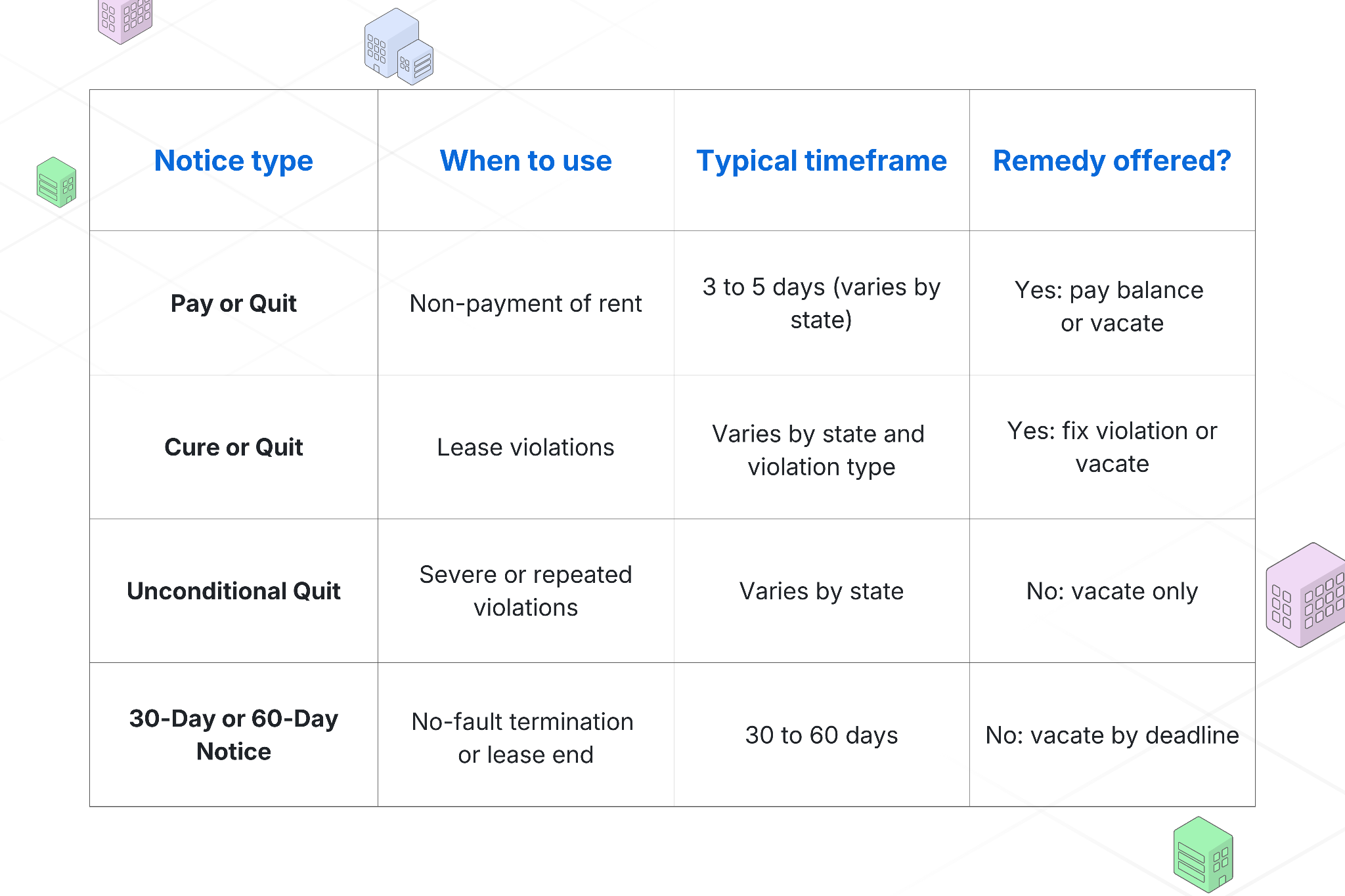
The required notice type and timeframe depend on the violation. There is no single universal timeline: a 3-day notice may be legally sufficient for non-payment in one state, while another requires 14 days or more.
A 30-day notice is typically required for no-fault terminations or month-to-month tenancies in many states.
On service method: sheriff service is not universally required. Most states permit personal service, posting on the unit door, or certified mail.
Property management teams should confirm the legally acceptable service method for each jurisdiction where they operate, or use a licensed process server to eliminate dispute risk.
Step 2: File an Eviction Lawsuit
If the tenant does not comply with the notice, the next step is filing a formal complaint, sometimes called an Unlawful Detainer, with the local court. Filing fees typically range from $50 to $300, depending on the jurisdiction.
The tenant must then be served with the court summons, creating an official record that the action is pending.
Property management teams that handle volume filings often work with a retained eviction attorney to standardize this step. The attorney handles paperwork preparation, filing, and service, which reduces errors that can delay or dismiss a case.
Step 3: Attend the Court Hearing
Both the landlord and the tenant appear before a judge. The landlord must bring the signed lease agreement, a complete payment history, proof that the eviction notice was properly served, and documentation of the violation.
Teams that maintain organized unit files win hearings. Teams that do not often lose on procedural grounds, not factual ones.
Tenants can raise defenses at the hearing, including claims that the unit was not maintained in a habitable condition or that the notice was improperly served. Both are arguments that strong documentation neutralizes.
Step 4: Obtain the Writ of Possession
If the judge rules in favor of the landlord, the court issues a Writ of Possession. This document authorizes a sheriff or constable to notify the tenant that they must vacate by a specific date.
Timelines for writ issuance vary by jurisdiction and court backlog, and this is often where the process slows down in high-volume markets.
Step 5: Regain the Property
If the tenant does not vacate voluntarily, law enforcement supervises the physical removal.
The operator is responsible for arranging a locksmith and coordinating the handling of any belongings the tenant leaves behind, which must follow state-specific abandoned property laws.
Moving efficiently through this step minimizes vacancy days and gets the unit back into rentable condition.
How Long Does the Eviction Process Take?

The timeline from serving a notice to regaining possession can range from a few weeks to several months.
The primary variables are state law, court backlog, and whether the tenant contests the eviction. States with streamlined eviction courts, such as Florida, often move faster than high-volume markets in states like New York or California, where court backlogs can add weeks to the process.
If a tenant files for bankruptcy during the proceeding, an automatic stay can pause the eviction entirely, sometimes for months.
For property management teams, the practical implication is that every day in the process is a day of lost rent. Aiming for procedural accuracy at Step 1 and Step 2 is the single most effective way to avoid restarts and delays that extend that vacancy window.
How Much Does Evicting a Tenant Cost?
Total eviction costs typically range from $4,000 to $7,000 per case, and contested evictions can run higher.
That figure covers court filing fees, attorney fees, law enforcement coordination, property repairs, cleaning, and the rental income lost while the unit sits vacant through the process. It does not account for staff time, which is a real cost for management teams handling the documentation, court appearances, and coordination involved.
For operators managing portfolios at scale, even a modest eviction rate compounds quickly. Two or three evictions per quarter across a portfolio represents a meaningful line item, and that number grows with contested cases, rent-controlled units, or jurisdictions with slower court systems.
Best Practices for Property Management Teams
The following practices apply at the team and systems level, not just the individual case level.
Do Not Accept Partial Rent Once You Have Filed
Accepting a partial rent payment after filing can legally void the eviction in many states and force the process to restart from the beginning.
Property management teams need a clear written policy on this, shared with all leasing and property staff. If a tenant offers payment after a notice has been served, your team should know exactly what to do before that conversation happens.
Build a Documentation System Before You Need It
Operators who win eviction hearings consistently share one characteristic: organized records.
That means signed leases, move-in inspection reports, timestamped communication logs, complete payment histories, and a chronological violation notice file for every unit. This should be a team-level standard, not something assembled case by case when a filing becomes necessary.
Enforce Consistently Across All Units
Inconsistent enforcement is a fair housing liability. Apply the same standards, the same notice timelines, and the same documentation requirements to every lease violation across your portfolio.
If your team makes exceptions for some tenants, document the business reason. If exceptions happen without documentation, you have created risk.
Know When to Use an Eviction Attorney
Straightforward non-payment cases in familiar jurisdictions can often be handled in-house with a reliable process.
An eviction attorney becomes the right call when the tenant has their own legal representation, when the tenant files for bankruptcy, when the unit is subject to rent control, or when the case involves a contested lease violation.
For management companies handling volume filings, a retained eviction attorney often reduces total cost by preventing procedural errors that cause restarts.
Consider Cash for Keys
Cash for keys is a negotiated alternative to a contested eviction. The operator offers the tenant a cash payment in exchange for voluntarily vacating the unit and signing a written agreement.
In markets with slow court systems or high filing costs, this can be the faster and cheaper path to getting the unit back. Treat it as a cost-benefit calculation: compare the cash offer against the projected cost of a contested filing in your jurisdiction.
The Best Eviction Strategy Is One You Rarely Use
Every eviction filing is evidence of a qualification decision that did not work out.
The $4,000 to $7,000 cost, the weeks or months of vacancy, and the management team hours spent on notices, filings, and court appearances all trace back to a tenant who should not have been approved, or a risk that was not adequately mitigated at move-in.
Thorough screening is the foundation: credit history, criminal background, eviction history, and verified income documentation.
For applicants who do not meet standard income requirements but are otherwise qualified, rent guarantors and co-signer programs offer a way to fill units while protecting the operator from non-payment risk.
Cosign helps property management teams qualify more applicants and protect more units by acting as a rent guarantor for residents who need one. Instead of leaving a unit vacant or accepting a high-risk tenancy, operators can approve the applicant and transfer the default risk.
The result is higher occupancy and fewer eviction filings.
Frequently Asked Questions
How long does it take to evict a tenant in the US? The timeline ranges from a few weeks to several months. State law, court backlog, and whether the tenant contests the eviction are the main variables. Fast-moving states like Florida can resolve uncontested cases in two to four weeks. High-volume markets in states with backlogged courts can take three to six months or longer. A tenant bankruptcy filing can pause the process entirely.
How much notice does a landlord have to give before eviction? It depends on the violation type and state law. Non-payment notices are typically 3 to 5 days in most states. Lease violation notices vary more widely. No-fault terminations and month-to-month tenancies often require 30 to 60 days. There is no single nationwide standard, which is why property management teams should confirm requirements for each jurisdiction where they operate.
Can a tenant pay rent after receiving an eviction notice? Yes, and in many cases, a Pay or Quit notice gives the tenant exactly that option: pay the full balance owed or vacate. If the tenant pays in full before the notice period expires, the eviction does not proceed. The operator decision point comes after filing: accepting partial payment mid-process can void the eviction in many states. Property management teams should have a written policy in place before this situation arises.
Does an eviction notice have to be served by a sheriff? No. Most states allow personal service, posting on the unit door, or certified mail as legally valid methods for serving an eviction notice. Sheriff service is typically involved later in the process, when a Writ of Possession is executed. Property management teams should verify acceptable service methods in each jurisdiction or use a licensed process server to reduce the risk of a challenge.
Is a 14-day eviction notice legal? It depends on the state and the violation type. Some states require only 3 to 5 days for non-payment notices, while others require 14 days or more. A 14-day notice is legally valid in jurisdictions that require it, and may be longer than required in states with shorter minimum periods. Always confirm the minimum notice period for your specific violation type in the relevant state before serving.
Protecting Your Portfolio Starts Before Move-In

The eviction process for landlords in the US is a strictly regulated legal procedure.
When it is necessary, following it correctly protects your ability to recover the unit and limits liability exposure. Proper notice, complete documentation, consistent enforcement, and legal counsel when the situation calls for it are the pillars of a sound eviction process.
But the operators who manage eviction risk most effectively are the ones who reduce how often they need to use this guide.
Rigorous screening, consistent qualification standards, and tools like rent guarantor programs give property management teams a way to fill more units with qualified residents while protecting against the non-payment risk that drives most eviction filings.
Protect your portfolio before the lease is signed. Cosign acts as a rent guarantor for qualified applicants who need one, helping property management teams approve more residents and reduce eviction risk.
.avif)
.avif)

.jpeg)

.jpeg)



Aumentemos tus tasas de ocupación


