


.svg)


Relocating for a New Job? How to Get Approved on an Apartment Before Your First Paycheck
.png)
TL;DR
- Most landlords require proof of income before approving a lease. If you are relocating for a new job, you likely have an offer letter but no pay stubs yet, which standard screening models treat as a documentation gap.
- You are not unqualified. You are between paychecks, and while those are not the same thing, most screening systems treat them that way.
- There are five strategies that actually work: presenting a strong offer letter package, paying additional rent upfront, getting a co-signer, using a professional cosigner service, or applying through a lease guarantor service like Cosign that covers the income verification gap directly.
- Cosign accepts job offer letters as proof of income, approves applicants in as little as 24 hours, and gives landlords a guaranteed apartment approval backed by real financial coverage.
- The fastest path to approval is combining a complete documentation package with a cosigner service or lease guarantor, so landlords have both the story and the protection.
You accepted the offer, gave notice, and found the neighborhood you want to live in. Then the apartment application asks for two months of pay stubs.
This is the wall that stops thousands of job relocaters every year, not because they cannot afford the apartment or because they are a credit risk, but because the standard income verification model was built for renters who have been employed at the same job for at least 60 days, and you are not that renter yet.
If you need a cosigner for an apartment, are trying to get approved before your start date, or just cannot figure out why your offer letter keeps getting dismissed, this guide explains what is happening and what to do about it.
Why Standard Screening Rejects New Hires
Landlords verify income to assess whether an applicant can reliably pay rent each month. The conventional method relies on pay stubs, W-2s, or bank statements showing consistent deposits, all of which require existing employment history.
A job offer letter proves future income, not current income, and most standard screening processes have no clear framework for evaluating it, so they default to a decline or a conditional approval that requires a co-signer. This is not a judgment on your financial stability. It is a limitation of the screening model.
According to Apartments.com, most apartment applications take 24 to 72 hours to process. For relocating new hires, the process often stalls at income verification and can stretch significantly longer, or stall out entirely, if the leasing team has no framework for offer-letter approvals.
The good news is that you have more options than waiting for your first paycheck.
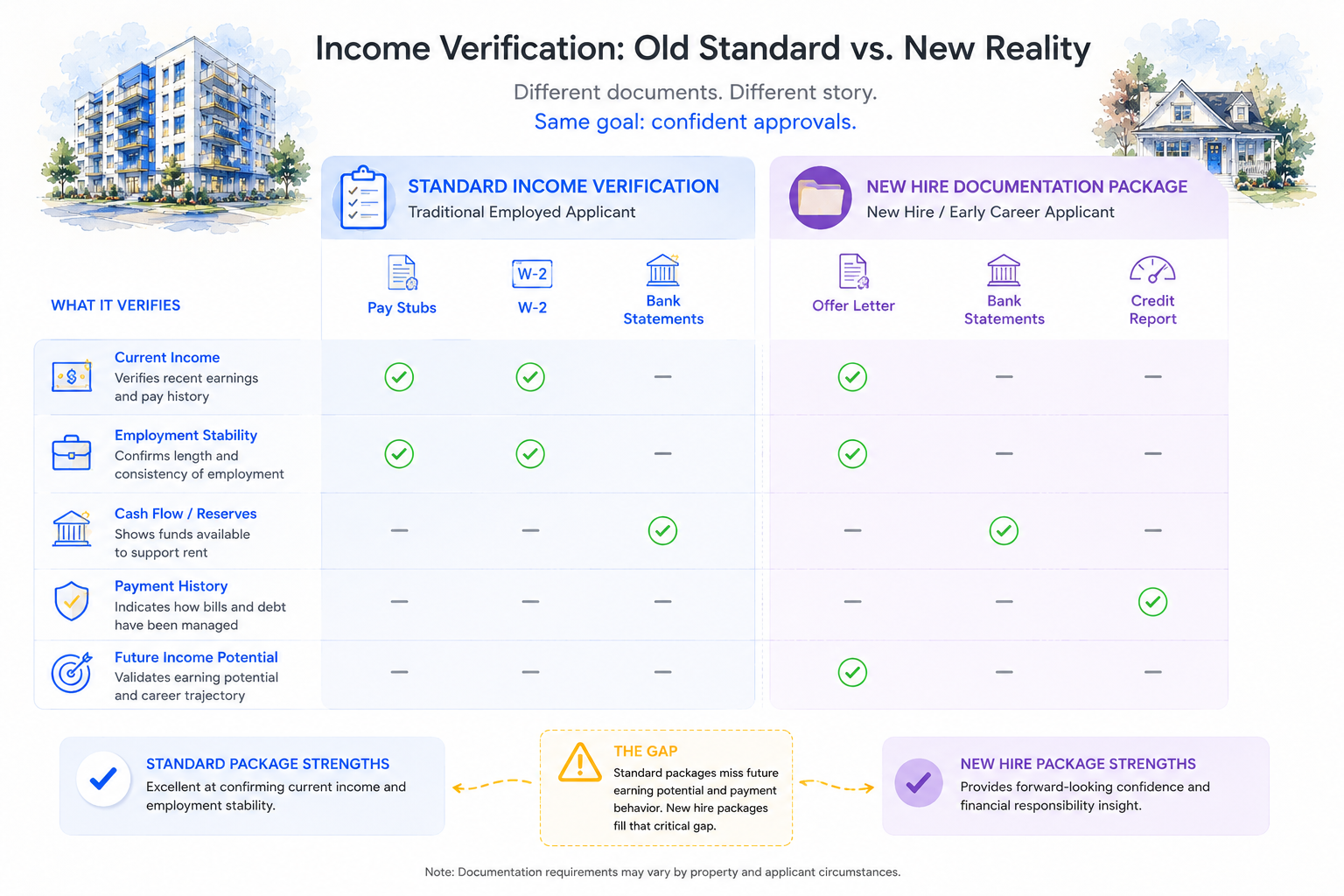
What Documentation Actually Helps
Before pursuing a cosigner or guarantor, build the strongest possible application package. A complete file gives landlords less reason to hesitate and more reason to approve conditionally, even without a cosigner service behind it.
Your offer letter is the centerpiece. It should be on company letterhead, signed, and clearly show your start date, title, and annual or monthly salary. If it does not show salary, ask your HR contact to provide a supplemental letter confirming compensation.
Pair it with three to six months of bank statements showing consistent savings or an existing balance. A landlord approving a new hire without pay stubs wants to see that you have funds to cover rent through the gap period before your first direct deposit arrives. Most income requirements ask for monthly gross income of at least three times the monthly rent, so if your offer letter meets that threshold and your bank account shows liquidity to cover two to three months, many landlords will at least consider the application.
A strong credit report helps significantly. Pull yours before applying so you know what is on it. A score above 680 with no collections or recent derogatory marks tells a leasing agent that your financial behavior is sound, even when income documentation is non-standard. Reference letters from previous landlords, if you have them, are also worth including because they address the behavioral question separately from the financial one.
When the Documentation Is Not Enough
Even a complete package may not be sufficient at every property. High-demand buildings in competitive markets often have enough traditionally documented applicants that they will not take the underwriting risk on a new hire, regardless of how strong the offer letter looks. When that happens, your options split into three paths: find an individual co-signer, hire a cosigner service, or apply through a lease guarantor service.
Individual co-signer. An individual who agrees to share liability on your lease must typically meet their own income and credit requirements, often showing annual income of 80x to 100x the monthly rent depending on the market. If you have a parent, relative, or close contact who meets those thresholds and is willing to take on that legal obligation, this can work. The limitation is that most adults in your network are not in a position to co-sign, and asking them puts a real financial burden on a personal relationship.
Hire a cosigner. Professional cosigner services exist specifically for situations where you need a cosigner for an apartment but do not have someone in your personal network who qualifies. These services act as institutional co-signers on demand. You pay a fee, they review your application, and if approved, they sign as co-applicant or guarantor to satisfy the landlord's requirement. The distinction between a co-signer and a guarantor matters here. A co-signer is typically a co-applicant with rights tied to the lease, while a guarantor carries financial liability only, without tenancy rights. When evaluating whether to hire a cosigner versus use a guarantor service, consider which structure your landlord requires.
Lease guarantor service. A lease guarantor service like Cosign operates as an institutional guarantor that underwrites your lease on your behalf. Instead of relying on an individual's income or assets, you apply directly to the guarantor platform. If approved, Cosign issues a guarantee to the landlord covering up to 12x your monthly rent in unpaid rent or damages, giving the landlord a guaranteed apartment approval backed by institutional coverage while you get the apartment.
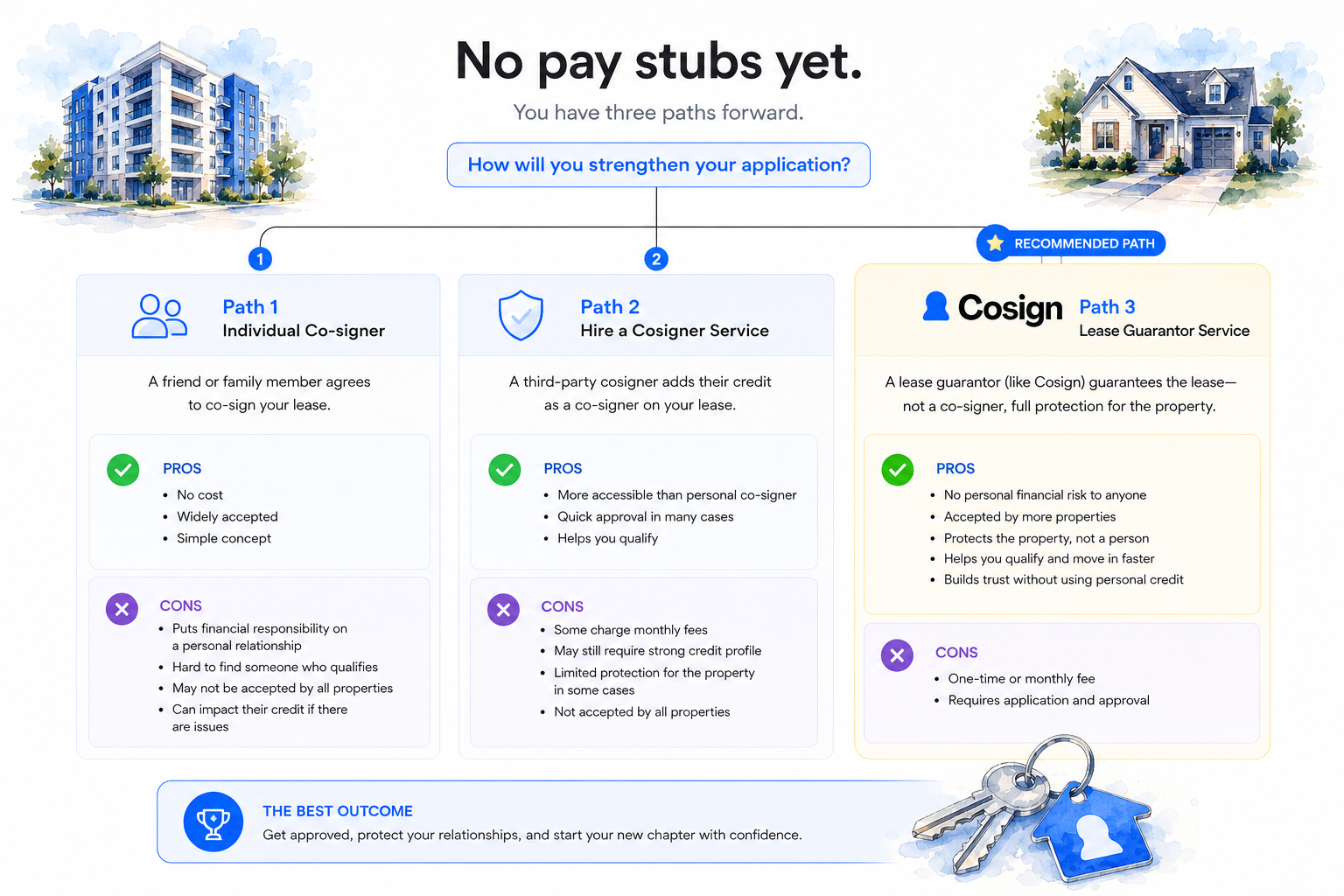
How a Cosigner Service Works in Practice
If you decide to hire a cosigner or use a lease guarantor service, you apply to the service online, typically submitting your offer letter, ID, bank statements, and basic personal information. The service evaluates your application using its own underwriting criteria, which are often more flexible than standard landlord screening because the service is taking on the financial exposure rather than asking the landlord to.
Cosign accepts job offer letters as proof of future income and reviews applications with both SSN and ITIN, which is relevant if you are relocating internationally. Average approval time is 24 hours, and if approved, Cosign issues the guarantee directly to the property. You choose a coverage tier from 3x to 12x your monthly rent, and the cost to the landlord is zero. You pay a one-time fee, with the exact amount varying based on your application profile and coverage tier.
For renters who want to understand the full difference between co-signers and guarantors before deciding, Cosign's guide to what a cosigner is and when you actually need one covers the distinction in plain language.
How to Frame Your Application to Landlords
How you present your situation matters as much as the documents themselves. Most leasing agents are not underwriters, they are following a checklist. If your application arrives without context, a missing pay stub looks like a red flag. With context, it reads as a timing issue with a clear resolution.
Include a brief cover note with your application, one paragraph explaining that you are a new hire relocating for a confirmed position, your start date and employer, and that you have attached your offer letter and bank statements. If you are applying with a cosigner service or lease guarantor, mention that upfront. Landlords who know the gap is covered are far more likely to move your application forward rather than flag it for follow-up.
Timing matters too. Apply as early as possible relative to your move-in date. Fast apartment approval timelines are typically 24 to 72 hours for standard applications, but non-traditional applications that require follow-up from a leasing manager can take longer. If you are starting a job in 45 days, begin your apartment search now, not in 30 days.
If you are struggling with the process itself, Cosign's guide to how to fill out an apartment application and get approved covers the full process with specific steps for non-traditional applicants.
What to Do If You Get Declined
A decline from one property is not a verdict on your application. Different buildings have different risk tolerances. A large institutional property managed by a national operator may have rigid screening rules with no room for exception, while a smaller property owner may be more willing to evaluate the full picture.
If you are declined, ask why, in writing if possible. Understanding whether the issue was income-related, credit-related, or a general policy gives you something specific to address before your next application. If income documentation was the issue, that is exactly what a cosigner service solves, so apply to Cosign before submitting your next application so the guarantee is already in place when it lands on the leasing manager's desk.
Some renters in relocation situations also find success applying to corporate housing or short-term furnished rentals for the first one to three months, using that time to accumulate pay stubs before transitioning to a standard lease. It adds cost and inconvenience, but it is a functional bridge if you are in a tight market and need to move quickly.
Frequently Asked Questions
Q: What is a guarantor on a lease, and do I need one as a new hire?
A: A guarantor on a lease is a third party, either an individual or an institutional service, that agrees to cover your rent obligations if you default. As a new hire without pay stubs, many landlords will require a guarantor or co-signer to offset the income documentation gap. A lease guarantor service like Cosign fills that role institutionally, without requiring you to find an individual willing to take on personal financial liability.
Q: Is it better to hire a cosigner or use a lease guarantor service?
A: Both fulfill the same basic function for the landlord by reducing default risk on your lease. A professional cosigner service that also offers guarantor structures, like Cosign, often provides cleaner documentation and faster turnaround than coordinating with an individual. For most new hire situations, a lease guarantor service is the more straightforward path.
Q: How fast can I get approved through Cosign if I need help getting approved for an apartment quickly?
A: Cosign's average approval time is 24 hours. Once approved, the guarantee is issued directly to the property, meaning you can move from application to guarantee in a single business day if the landlord accepts Cosign.
Q: Will my offer letter be accepted as proof of income?
A: It depends on the landlord. Most do not accept it under standard screening, but Cosign's underwriting process does, which is one of the specific use cases the platform was built to address.
Q: What does the best lease guarantor service look like for new hires specifically?
A: Look for a service that accepts offer letters, has fast approval timelines, is free to landlords, and offers flexible coverage tiers. Cosign meets all four criteria and has an established track record with multifamily properties across the country. Renters looking to compare options can read Cosign's guide to the best lease guarantor companies in 2026 for a full breakdown.
Q: How do I know if the apartment I want accepts Cosign?
A: Ask the leasing office directly, or apply to Cosign and let the team confirm compatibility with your target property. Cosign works with multifamily properties across the country and can often facilitate a conversation with the property if the building has not worked with the platform before.
.avif)
.avif)
.png)

.png)



Aumentemos tus tasas de ocupación


