


.svg)


How to Remove an Eviction From Your Tenant Screening Report

A past eviction can follow you for years. When you are apartment hunting, that single court filing can appear on tenant screening reports and get your application rejected before a landlord ever speaks with you.
Under the Fair Credit Reporting Act (FCRA), eviction records can stay on a screening report for up to seven years from the date of filing. That is a long time to carry a record, especially if the eviction was filed in error, the case was dismissed, or the debt has since been paid.
The good news is that removal is possible. Depending on your situation, you may be able to dispute the record, negotiate with your former landlord, or pursue a legal remedy such as expungement or sealing. This guide walks through each option so you know exactly where to start.
Where Evictions Show Up (and Where They Don't)
Tenant Screening Reports vs. Credit Reports
Eviction filings are public court records. Tenant screening companies, such as CoreLogic SafeRent, TransUnion SmartMove, and Experian RentBureau, pull those records directly and include them in the background check reports landlords use to evaluate applicants.
A common misconception is that evictions appear on a standard credit report. They do not. The eviction filing itself is not reported to the three major credit bureaus. However, if you owe unpaid rent or fees and your former landlord sends that balance to a collection agency, the resulting collection account will appear on your credit report and can cause real damage to your credit score.
How Long Does an Eviction Stay on Your Record?
Under the FCRA, most eviction records and related collections can remain on a tenant screening report for up to seven years from the date of filing. This clock starts at filing, not at the date you moved out or when the case was resolved.
Some states have enacted shorter reporting windows or additional tenant protections that limit how long an eviction can be reported. Check your state's landlord-tenant laws to confirm what applies to you.
How an Eviction Affects Your Credit Score
The eviction filing itself does not reduce your credit score. What hurts your score is the collection account that follows when unpaid rent or fees are sent to collections. The point drop varies by individual. Someone with a strong credit history may see a more significant decline, while someone who already has negative marks may see a smaller change.
Collections carry the most weight in the first two years after they are added to your report. Over time, their impact diminishes, but the account typically remains visible for seven years.
Step-by-Step: How to Remove an Eviction From Your Tenant Screening Report
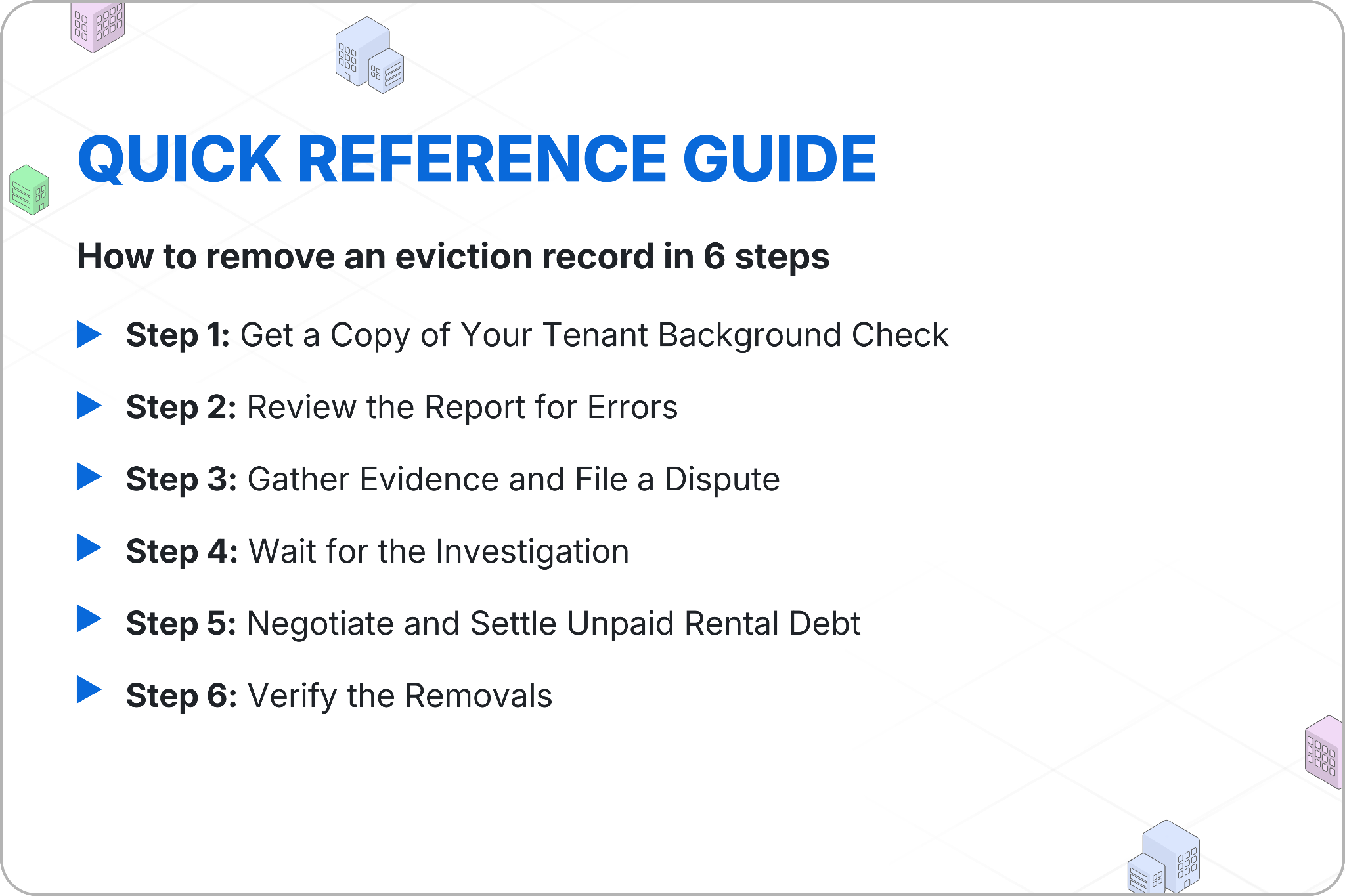
Step 1: Get a Copy of Your Tenant Background Check
Before you can dispute or remove anything, you need to see what is actually on your report. If a landlord has already denied your application, the FCRA requires them to provide an Adverse Action Notice. That notice must identify the screening agency and entitle you to a free copy of your report from that agency, typically within 60 days of the denial.
If you have not been denied yet, you can still request your report proactively. Common tenant screening agencies include CoreLogic SafeRent, TransUnion SmartMove, and Experian RentBureau.
Checking your report before applying gives you a chance to address problems before they cost you an apartment.
Step 2: Review the Report for Errors
Screening companies make mistakes more often than most renters realize. Read your report carefully and look for: evictions older than seven years that should have aged off, cases you won or that were dismissed but are still showing as active, sealed records that are still visible, and name mix-up errors where someone else's record has been attached to your file.
Any of these constitute an inaccuracy you have the legal right to dispute. Even if the eviction was real, errors in how it is reported may still be disputable.
Step 3: Gather Evidence and File a Dispute
Before filing, gather the documentation that supports your case. This may include rent payment receipts, a copy of your lease, a court order showing the case was dismissed, or any record confirming the debt was paid. The stronger your evidence, the more likely the dispute will succeed.
Disputes are filed directly with the tenant screening company, not with the landlord. Filing is free under the FCRA. Submit your dispute in writing and keep a copy of everything you send.
Step 4: Wait for the Investigation
Once you file a dispute, the screening company is required by law to investigate. They must verify the information with the original source, typically the court or the landlord, and respond within 30 days. If the record is found to be inaccurate or outdated, they are required to correct or remove it.
If your dispute is denied and you believe the agency is still reporting inaccurate information, you can escalate. File a complaint with the Consumer Financial Protection Bureau (CFPB) or consult a housing attorney about potential FCRA violations.
Step 5: Negotiate and Settle Unpaid Rental Debt
If the eviction is accurate and you owe an outstanding balance, paying or settling that debt is your next step. Contact the former landlord or collection agency and make an offer. They may be willing to accept a lump-sum settlement for less than the full amount owed.
When you reach an agreement, ask the landlord to request removal of the eviction from tenant screening reports as a condition of payment. At the same time, ask for removal of any related collection account from your credit report. Get both agreements in writing before making any payment.
Step 6: Verify the Removals
After a dispute is resolved or a debt is settled, do not assume the record has been cleared. Request updated reports from both the tenant screening agency and the relevant credit bureau. Confirm that the eviction and any related collection accounts have actually been removed.
If items are still showing after they should have been cleared, the written agreement from Step 5 becomes your primary evidence for a follow-up dispute or a complaint to the CFPB.
Legal Options to Remove an Eviction From Public Record
Sealing vs. Expungement: What's the Difference?
Sealing hides the eviction record from public view, including most tenant screening searches. The record still exists but is no longer accessible to landlords or screening companies.
Expungement removes the record entirely, as if the filing never occurred. It is a more complete remedy but is available in fewer states and under stricter eligibility requirements.
Availability varies significantly by state. Renters should confirm what their state allows before pursuing either option. A housing attorney or local legal aid organization can provide that guidance.
States With Eviction Record Relief Laws
A growing number of states have enacted specific frameworks for eviction record relief. Minnesota, Nevada, Oregon, and Utah are among the states that allow tenants to petition a court for sealing or expungement under certain conditions, such as a dismissed case or a fully paid debt. Eligibility requirements, procedures, and timelines vary by state.
If you are unsure what applies in your state, a local legal aid organization can help at low or no cost for renters who meet income thresholds.
Washington State's Order to Limit Dissemination
Washington State offers a specific remedy called an Order to Limit Dissemination (OLD). This court order legally prevents tenant screening companies from reporting the eviction to prospective landlords, even if the underlying court record still exists. It is a practical option for Washington renters who cannot pursue full expungement.
This is a Washington-specific remedy. Renters in other states should ask a housing attorney or legal aid organization whether an equivalent option exists in their state.
When to Hire a Housing Attorney or Use Legal Aid
Some situations are straightforward enough to handle on your own: disputing a clear error, settling a debt with a cooperative landlord, or filing a CFPB complaint. Others are not. If a screening company is unresponsive to a legitimate dispute, if you believe you were wrongfully evicted, or if you want to pursue sealing or expungement through the court, legal help is worth pursuing.
Free assistance is available through local legal aid organizations for renters who meet income thresholds. Search for your local legal aid office to find out whether you qualify.
What to Do If the Eviction Stays on Your Record
Build a Strong Renter Profile
A renter resume is a one-page summary of your employment history, income, rental history, and references. Bring it to every application. It gives a landlord a fuller picture of who you are before they fixate on the eviction.
Offer more references than the landlord asks for. Letters of recommendation from a previous employer or a personal reference who can speak to your reliability carry weight, especially with private landlords making case-by-case decisions.
Be Transparent With Prospective Landlords
Proactively disclosing an eviction, along with the context and any steps you have taken to resolve it, tends to land better than letting a landlord find it without explanation. A landlord who hears your side of the story before screening is more likely to consider it than one who discovers the record and has no context for it.
Look for Private Landlords and Offer a Higher Deposit
Large property management companies often follow rigid screening policies that leave little room for judgment. Private landlords are generally more flexible. Searching for single-family rentals or smaller buildings increases the likelihood you are dealing with an individual owner rather than a management company.
Offering a higher security deposit or one to two additional months of rent upfront demonstrates financial reliability and reduces the perceived risk for a landlord who might otherwise pass.
Consider a Co-signer or Rent Guarantor
A co-signer with strong credit takes on legal responsibility for the lease alongside you. If you default, they are on the hook. Not everyone has a family member or friend willing to take on that risk, but when available, a co-signer can make a meaningful difference.
A rent guarantor service works similarly: it backs the lease financially, giving the landlord a layer of protection and the renter a path to qualify that would not otherwise be available. This option is especially useful for renters who narrowly miss a landlord's income or credit threshold. Cosign is one such service, built for renters who just missed the qualification threshold.
Moving Forward After an Eviction

An eviction on your tenant screening report is not a permanent barrier. Whether it gets removed depends on whether the record is accurate, how much time has passed, and what legal options exist in your state. But in every case, you have more control than you might think.
Start by pulling your report and reading it carefully. Know your FCRA rights. If there is an error, dispute it. If there is a debt, address it and negotiate removal as part of the resolution. If the record is accurate and recent, explore whether your state offers sealing or expungement, and build a renter profile strong enough to give landlords reason to look past it.
For renters who have done the work but still need help crossing the qualification threshold, Cosign is a rent guarantor tool built exactly for that gap.
Frequently Asked Questions
How long does an eviction stay on a tenant screening report? Up to seven years from the date of filing under the FCRA. Some states have shorter reporting windows. Check your state's landlord-tenant laws to confirm what applies to you.
Does an eviction show up on my credit report? The eviction filing itself does not appear on a credit report. However, unpaid rent or fees sent to a collection agency will appear as a collection account and can damage your credit score.
How much does it cost to dispute an eviction record? Filing a dispute directly with a tenant screening agency is free. The FCRA requires these agencies to investigate disputes at no charge to the consumer.
How many points does an eviction drop my credit score? The eviction filing itself does not affect your credit score. Collections tied to an eviction do. The point drop depends on your existing credit history. Those with stronger credit tend to see a larger decline. Collections carry the most weight in the first two years after being added to your report.
What if my dispute is rejected? You can escalate by filing a complaint with the Consumer Financial Protection Bureau (CFPB) or by consulting a housing attorney about potential FCRA violations. Keep copies of all correspondence with the screening agency.
Can I rent an apartment while an eviction is still on my record? Yes. Private landlords, a higher security deposit, a renter resume, references, a co-signer, and rent guarantor services can all improve your options while a record remains on file.
.avif)
.avif)







Aumentemos tus tasas de ocupación


